
All plant species
9 species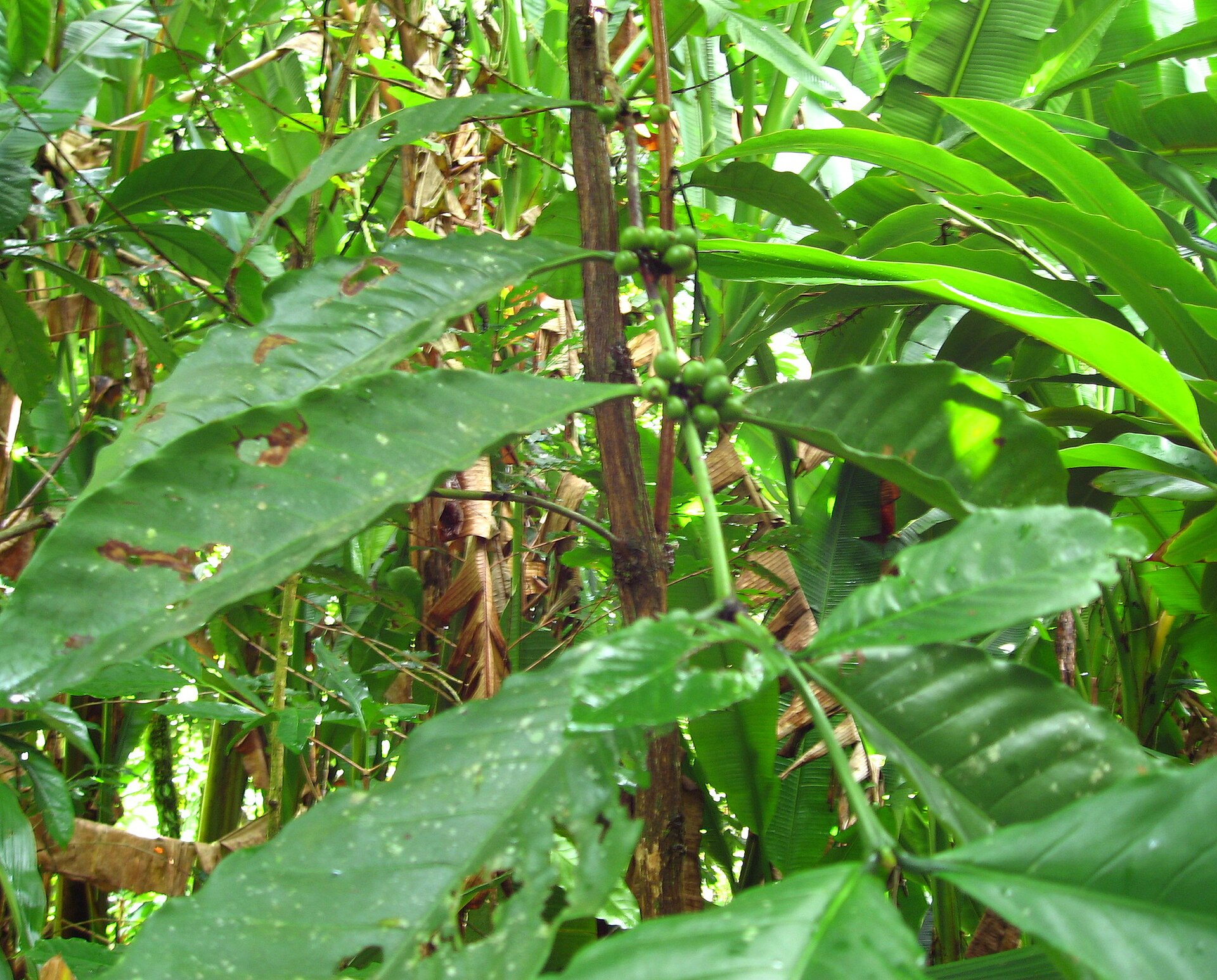 EN
Arabica coffee
Coffea arabica L.
Rubiaceae family
Arabica coffee (Coffea arabica L.) is a small evergreen tree in the coffee family (Rubiaceae) whose berry ('cherry') holds two coffee beans; it is the world's most widely grown coffee species, accounting for about 60% of global coffee products. According to Kew POWO its native range is E. South Sudan, SW. Ethiopia and N. Kenya (Mt. Marsabit), with Yemen as a secondary centre of spread from the 14th century. The bean contains caffeine (about 1.2–1.5% of dry weight) and chlorogenic acids (5–8%), plus trigonelline and the diterpenes cafestol/kahweol that shape flavour and aroma. In Vietnam, coffee is the key cash crop of the Central Highlands (Dak Lak, Lam Dong, Gia Lai, Dak Nong).
 NE
Cotton
Gossypium hirsutum L.
Malvaceae family
Upland cotton (Gossypium hirsutum L.) is a crop of the family Malvaceae and the source of the world’s single most important textile fibre. Native to Mexico and Central America and domesticated long ago, it is now the most widely grown cotton species, accounting for most global production. The fibre is almost pure cellulose; the seeds yield edible oil after refining but contain gossypol, a toxic compound once studied as a male contraceptive.
 NE
Derris
Derris elliptica (Wall.) Benth.
Legume family
Derris roots contain rotenone, a compound toxic to fish and insects, historically used as a botanical insecticide.
 LC
Jatropha
Jatropha curcas L.
Spurge family
Jatropha bears oil-rich, inedible seeds researched as a biodiesel feedstock and is also grown as a living fence.
 NE
Jute
Corchorus olitorius L.
Malvaceae family
Jute mallow (Corchorus olitorius L.), also called Tossa jute, is an annual herb of the family Malvaceae and the source of a bast fibre that ranks second only to cotton in natural-fibre production. Native to tropical Africa and/or South Asia (still debated), it was domesticated for fibre mainly in India and Bangladesh. Jute is strong, cheap and biodegradable and is used for sacking, burlap, carpet backing, ropes, pulp and eco-friendly materials; the young leaves (jute mallow, molokhia) are edible, while the seeds contain cardiac glycosides (corchorin) and are not eaten.
 NE
Neem
Azadirachta indica A.Juss.
Mahogany family
Neem (Azadirachta indica) is an evergreen tree of the mahogany family with fragrant white flowers and oily drupes; the whole plant contains azadirachtin and is used in traditional medicine and biopesticides, widely grown in South Asia and Vietnam.
 NE
Ramie
Boehmeria nivea (L.) Gaudich.
Nettle family
Ramie (Boehmeria nivea (L.) Gaudich.), also called China grass, is a perennial herb of the family Urticaceae and the source of one of the oldest natural fibres. Native to East and South-East Asia, it was domesticated for fibre more than 6,000 years ago in China. The fibre is a bast fibre taken from the stem bark and is mainly cellulose; it stands out for high strength, natural lustre, low elongation and resistance to fungi and rot, and is therefore woven into premium fabric, load-bearing cordage, geotextiles and technical papers.
 NE
Rubber tree
Hevea brasiliensis (Willd. ex A.Juss.) Müll.Arg.
Euphorbiaceae family
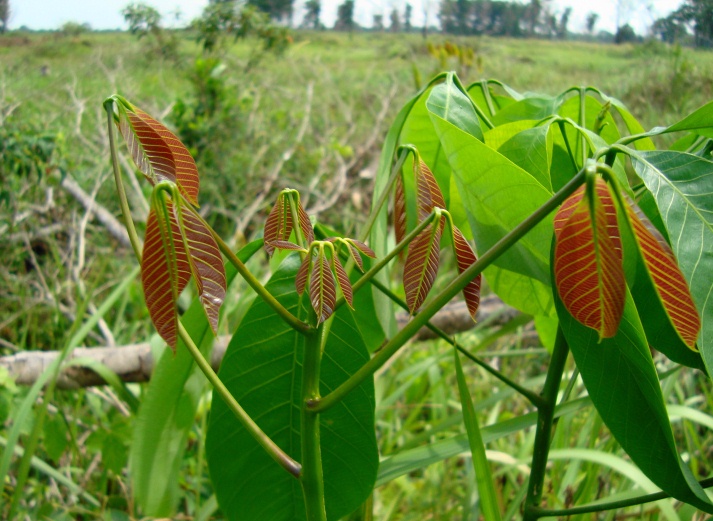
The rubber tree (Hevea brasiliensis) is a large deciduous tree of the spurge family (Euphorbiaceae), native to the Amazon basin (S. Tropical America per Kew POWO: Bolivia, Brazil, Colombia, French Guiana, Peru, Venezuela). Its bark holds latex vessels yielding a white emulsion of about 60% water and 33–35% cis-1,4-polyisoprene — natural rubber, one of the most important elastic polymers. After vulcanisation was invented (1839), rubber was carried from the Amazon to Asia, and Thailand, Indonesia, Vietnam, India, China and West Africa are now the main producers. The latex contains allergenic proteins (Hev b 1–15); the IUCN lists the species as Least Concern (LC, 2020).
 NE
Sugarcane
Saccharum officinarum L.
Grass family
Sugarcane (Saccharum officinarum L.) is a perennial grass of the family Poaceae whose jointed stalks grow 2–7 m tall and store sucrose in the internodes, the main raw material of the sugar industry and of bioethanol. According to Kew POWO it is native to New Guinea and was domesticated by Papuans from the wild ancestor Saccharum robustum about 6,000 years ago, then spread across the tropics by Austronesian voyagers. It is the world's largest crop by production quantity (about 1.9 billion tonnes in 2020), with Brazil accounting for roughly 40%. Besides sucrose, cane juice is rich in polyphenols (caffeic, chlorogenic, tricin, apigenin, luteolin) and cane wax contains policosanols (octacosanol) and D-003. In Vietnam it is grown in Thanh Hoa, Nghe An, Phu Yen, Tay Ninh and Hau Giang, among others, for sugar and fresh juice.