
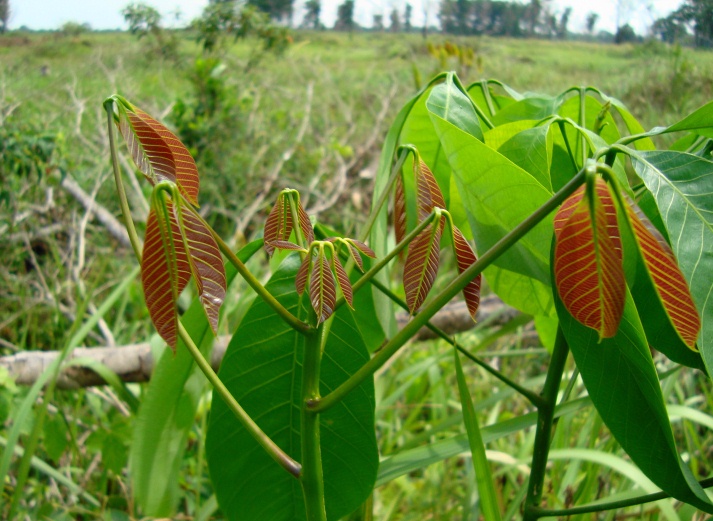
Rubber tree
Hevea brasiliensis (Willd. ex A.Juss.) Müll.Arg.
The rubber tree (Hevea brasiliensis) is a large deciduous tree of the spurge family (Euphorbiaceae), native to the Amazon basin (S. Tropical America per Kew POWO: Bolivia, Brazil, Colombia, French Guiana, Peru, Venezuela). Its bark holds latex vessels yielding a white emulsion of about 60% water and 33–35% cis-1,4-polyisoprene — natural rubber, one of the most important elastic polymers. After vulcanisation was invented (1839), rubber was carried from the Amazon to Asia, and Thailand, Indonesia, Vietnam, India, China and West Africa are now the main producers. The latex contains allergenic proteins (Hev b 1–15); the IUCN lists the species as Least Concern (LC, 2020).
No ratings yet — be the first!
Gallery
 Rubber — Latex collection


 Rubber tree — Plant
 Rubber tree — LeavesRubber — Latex collection
Photo credits: Wagino 20100516 (CC BY-SA 3.0)
Overview
The rubber tree (Hevea brasiliensis) is a large deciduous tree up to 43 m tall in the wild, though much smaller in tapping plantations (usually 15–25 m). The trunk is cylindrical, sometimes with a swollen, bottle-shaped base; the bark is brown and its inner layer holds latex vessels that spiral up in a right-handed helix at about 30° to the horizontal and can reach 15 m high. The leaves are trifoliate and spirally arranged, and the tree is deciduous for a short dry season. The flowers are unisexual (separate male and female), creamy yellow and petal-less, borne in pungent clusters. The fruit is a capsule with three large seeds that splits explosively when ripe. The chromosome number is 2n = 36.
According to Kew POWO the native range of Hevea brasiliensis is South Tropical America — Bolivia, Brazil North/South/West-Central, Colombia, French Guiana, Peru and Venezuela — where it is a forest tree of humid tropical habitat. Amazonian peoples used rubber latex long ago; after Goodyear's invention of vulcanisation in 1839 demand surged, triggering the Amazon rubber boom (1840–1913) that enriched Belem, Manaus and Iquitos. Attempts to grow the tree outside Brazil began in 1873; in 1875–1876 Henry Wickham brought some 70,000 seeds to Kew, from which about 2,000 seedlings were sent to Ceylon (Sri Lanka) and Singapore, and then to Buitenzorg (Java) in 1883. Because South American leaf blight ravaged its homeland, large plantations shifted to Asia; by 1898 Malaya had rubber estates, and today Thailand, Indonesia, Vietnam, India, China and West Africa are the main producing regions.
Fresh rubber latex is a white emulsion of about 60% water, 33–35% cis-1,4-polyisoprene (natural rubber) and about 5% non-rubber matter. The rubber particles are about 0.5 µm across, and the polymer has a molecular weight (Mw) of roughly 5×10^5–2×10^6 Da, giving its characteristic elasticity. The non-rubber fraction includes proteins (Hev b 1 — rubber elongation factor, REF; Hev b 3 — small rubber particle protein, SRPP; Hev b 2 — β-1,3-glucanase; Hev b 6 — hevein… making up the 15 allergens Hev b 1–15), lipids and phospholipids, carbohydrates with the cyclitol quebrachitol, resin, flavonoids and mineral salts. The seeds also contain cyanogenic glycosides (linamarin) as a defence, their carbon and nitrogen recyclable for growth and latex production. Commercial latex typically holds 30–35% rubber solids.
Rubber is a strategic industrial material. Vulcanisation (1839) turns polyisoprene into a durable, elastic elastomer used for tyres, inner tubes, shoe soles, belts, conveyor belts and anti-vibration mounts; concentrated latex, ribbed smoked sheet (RSS) and technically specified rubber (TSR) go into medical gloves, condoms, catheters, teats and adhesives. Rubberwood is made into furniture once plantations pass tapping age (25–30 years), and rubber seed oil is used in paints, soap and biodiesel. In research, Berthelot et al. (2012) clarified the roles of REF (Hev b 1) and SRPP (Hev b 3) in latex allergy; Guyot & Le Guen (2018) reviewed a century of work on South American leaf blight; and recent reviews explore rubber latex as a biocompatible biomedical and sensor material while seeking alternative rubber sources (guayule, Russian dandelion Taraxacum kok-saghyz).
On safety, natural rubber latex allergy is a significant occupational health issue: an estimated 150,000–1 million healthcare workers and over 15 million people worldwide are affected, through the Hev b proteins; powdered gloves disperse allergens into the air, so low-protein gloves are now preferred. Solvents, preservative ammonia and processing chemicals require safe handling. In the past arsenic trioxide was used on plantations (notably in Malaysia), with environmental risk. On conservation, the IUCN lists Hevea brasiliensis as Least Concern (LC) in its 2020 assessment (Fabriani & Hills, e.T62003521A62003529). However, plantation clones have a very narrow genetic base and are all susceptible to South American leaf blight caused by the fungus Pseudocercospora ulei (formerly Microcyclus ulei), so wild Amazonian populations and genebanks are vital breeding resources; deforestation and monoculture threaten this gene pool.
Life cycle
From seed to productSeed
Rubber seeds are large but cannot be stored for long, so they must be sown fresh.
Germination
In warm, humid conditions seeds germinate within 1 – 3 weeks.
Seedling
Seedlings grow fast and love full sun; they are planted in rows together with shade or fertiliser trees.
Mature plant
The mature tree is a large 25 – 35 m forest tree; five to seven years after planting the trunk is thick enough for tapping to begin.
Tapping
A spiral cut reaches the laticifer layer just above the wood and latex flows into a cup; trees rest during the dry season to recover.
Harvest
Fresh latex is collected regularly from the cuts, preserved with ammonia or coagulated with acid, then dried into block rubber (TSR) and smoked sheets.
Distribution & origin
Share of recorded occurrences by region- Thailand32%
- Indonesia19%
- Vietnam9%
- Ivory Coast & West Africa9%
- India6%
- China6%
- Malaysia & Philippines5%
- Elsewhere (Brazil, Sri Lanka, Cambodia…)14%
Chemical composition
Relative content in agarwood resin- WaterAbout 60% of fresh latex60%
- cis-1,4-Polyisoprene (natural rubber)33–35% of latex; the elastic polymer33%
- Proteins (Hev b 1–15)REF, SRPP, hevein…; cause latex allergy3%
- Lipids & phospholipidsStabilise the rubber particles2%
- Carbohydrates & cyclitol (quebrachitol)In the latex serum1%
- Resin, flavonoids & mineralsColour and impurities1%
Uses
- Tyres, inner tubes, shoe soles, belts, conveyor belts and anti-vibration mounts
- Medical products: gloves, condoms, catheters, teats (need protein reduction)
- Concentrated latex, ribbed smoked sheet (RSS), TSR, glues and adhesives
- Rubberwood for furniture and boards
- Rubber seed oil for paints, soap and biodiesel
- Research/biomaterials: biocompatible latex; alternative rubber sources (guayule, Taraxacum kok-saghyz)
Properties
- Fresh latex colour
- Opaque white
- Specific gravity
- 0.91 – 0.93 g/cm³
- Glass transition
- ≈ −70 °C
- Polymer content
- ≈ 92% dry rubber
Habitat & conservation
Humid tropical rainforest of the Amazon basin, on lowland sites; the tree favours warmth and moisture, about 25–28 °C, at least about 1,200 mm of rain a year and no frost (a single frost can make a whole plantation's rubber brittle and liable to break when processed). Soils should be deep, friable, well drained and rich in organic matter. It is light-demanding, sheds its leaves in a short dry season and suits humid tropical lowlands.
Conservation
The IUCN lists Hevea brasiliensis as Least Concern (LC) in its 2020 assessment (Fabriani & Hills, e.T62003521A62003529), reflecting its wide cultivation across the tropics. Wild populations survive only in the Amazon basin and are shrinking through deforestation. A major weakness is the very narrow genetic base of plantations: most trees are clonal hybrids from a handful of clones, all susceptible to South American leaf blight caused by the fungus Pseudocercospora ulei (formerly Microcyclus ulei) — the disease that ended South American cultivation and a potential threat to Asian plantations. Conservation priorities are to protect wild Amazonian populations and genetic diversity in genebanks for disease-resistant breeding, avoiding monoculture and deforestation.
References
- 1Plants of the World Online — Hevea brasiliensis (Willd. ex A.Juss.) Müll.Arg. (Linnaea 34: 204, 1865) — Kew Science, 2026
- 2Hevea brasiliensis — IUCN Red List e.T62003521A62003529 — Fabriani & Hills, International Union for Conservation of Nature (IUCN), 2020
- 3Biochemical composition of Hevea brasiliensis latex: protein, lipid, carbohydrate and mineral contents — HAL/INRAE, 2020
- 4Rubber elongation factor (REF, Hev b 1) and small rubber particle protein (SRPP, Hev b 3) in Hevea latex — Berthelot et al., PLoS ONE, 2012
- 5A Review of a Century of Studies on South American Leaf Blight of the Rubber Tree — Guyot & Le Guen, Plant Disease, 2018
- 6Alternative sources of natural rubber — Mooibroek & Cornish, Applied Microbiology and Biotechnology, 2000
- 7Cyanogenic Glycosides: Synthesis, Physiology, and Phenotypic Plasticity — Gleadow & Møller, Annual Review of Plant Biology, 2014
- 8Allergen nomenclature — Hevea brasiliensis (Hev b) allergens — WHO/IUIS Allergen Nomenclature, 2024
- 9Statistical Report of the International Rubber Study Group — natural rubber production — International Rubber Study Group (IRSG), 2024