
Cashew
Anacardium occidentale L.
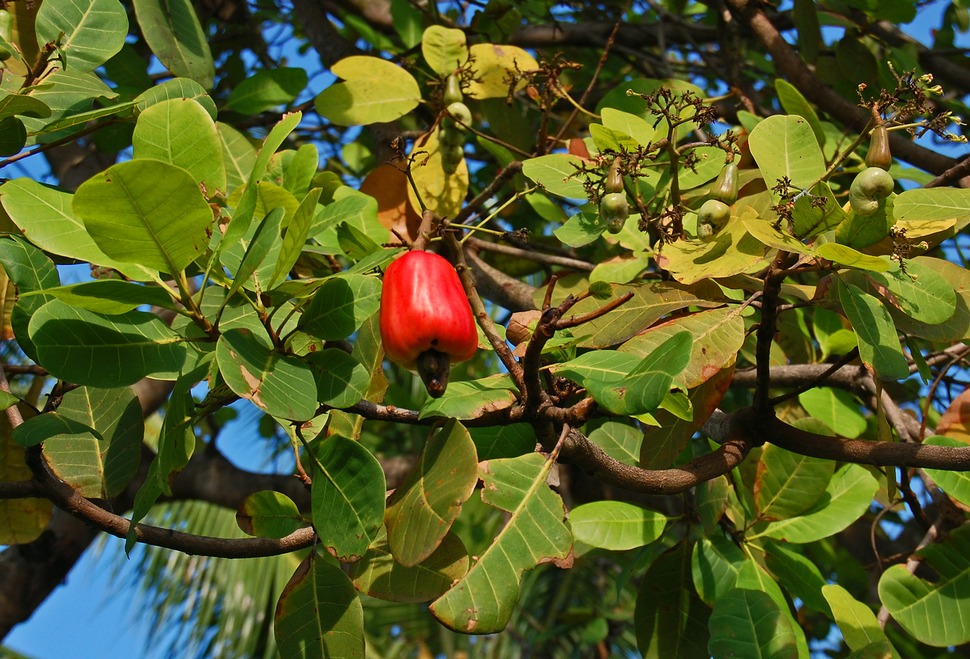
Cashew (Anacardium occidentale L.) is an evergreen tree of the family Anacardiaceae, native to tropical South America (Brazil, especially the north-east). Its fruit consists of the 'cashew apple' — in fact the swollen pedicel and receptacle (a false fruit) — and the true fruit, a kidney-shaped drupe holding the seed. The shell liquid (CNSL) contains anacardic acid, cardol and cardanol, which cause contact dermatitis but are important industrial raw materials (epoxy resins, paints, brake linings); the kernel is rich in lipid (about 44%) and protein. In 2024 world production of raw cashew nuts was about 4.24 million tonnes, led by Ivory Coast and India; Vietnam is the world's largest processor and exporter of cashew kernels.
No ratings yet — be the first!
Gallery
 Cashew — False fruit & nutsĐiều · ảnh 1
 Điều · ảnh 2
 Điều · ảnh 3
 Cashew — Tree & fruit
 Cashew — Fruit stalk & nutCashew — False fruit & nutsĐiều · ảnh 1
Photo credits: Wibowo Djatmiko (Wie146) (CC BY-SA 3.0) · Sidheeq at ml.wikipedia (Public domain) · Aruna at Malayalam Wikipedia (CC BY-SA 3.0)
Overview
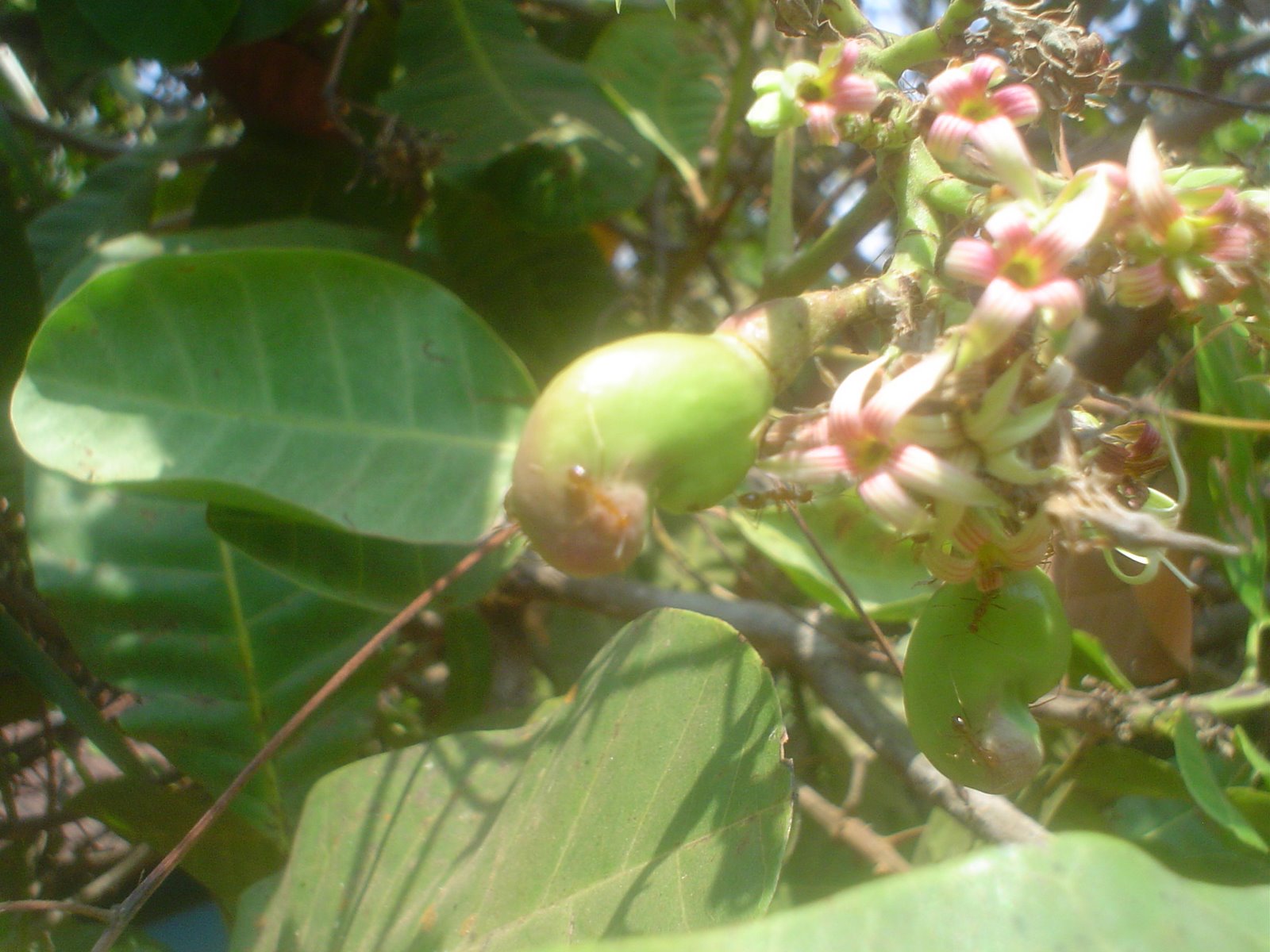
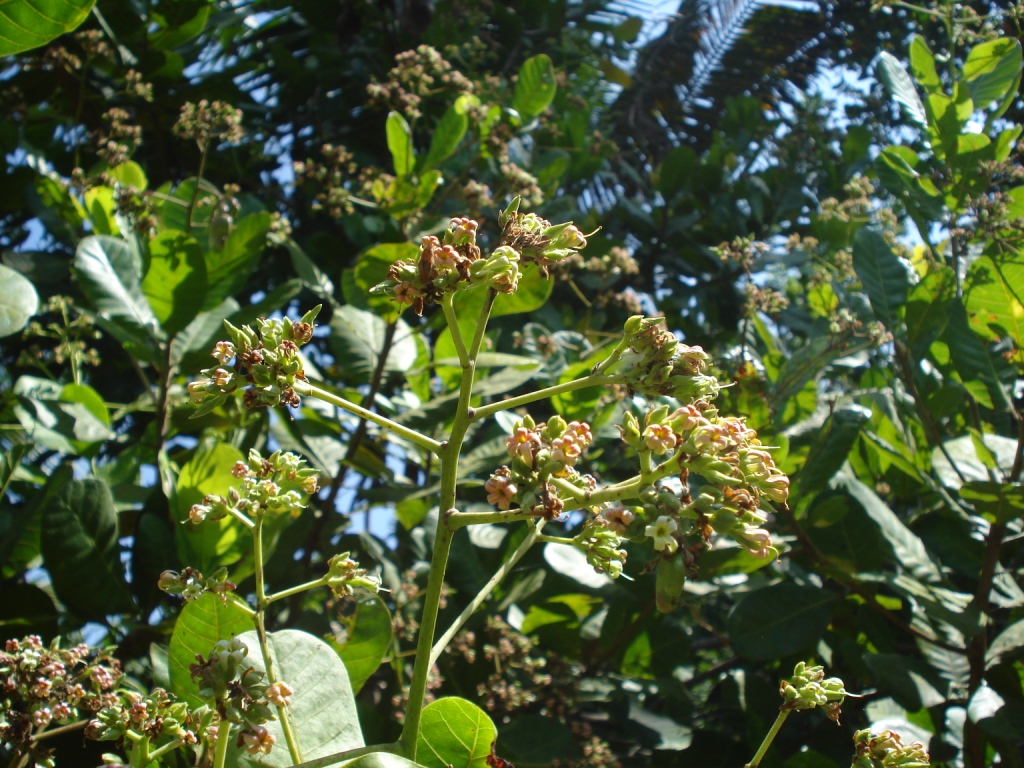
The cashew is an evergreen or semi-deciduous tree 8–14 m tall with a broad crown and a short trunk that usually branches low. The leaves are simple, spirally arranged, obovate to elliptic, 4–22 cm long and 2–15 cm wide, leathery, glossy, hairless, with smooth margins. The flowers are small, bisexual and male flowers on the same tree, borne in terminal panicles up to 26 cm long; there are five petals, pale green at first and turning reddish, and usually 8–10 stamens. The fruit has two parts: the 'cashew apple' (a false fruit or hypocarpium) is the swollen pedicel and receptacle, 5–11 cm long, ripening yellow or red and edible; hanging at its base is the true fruit, a kidney-shaped drupe with a hard two-layered shell holding the irritating cashew nut shell liquid (CNSL) and one seed. The tree starts bearing after about 3 years and gives economic harvests after about 8 years; the chromosome number is 2n = 42.
According to Kew POWO, Anacardium occidentale originates in tropical South America, native to Brazil (especially the north-east) and extending to Peru, Bolivia and Paraguay; its centre of diversity and domestication is the caatinga of north-eastern Brazil. Portuguese explorers encountered it in Brazil in the 16th century and took it to Goa (India) around 1560–1565, from where it spread through Southeast Asia and Africa. Today cashew is grown throughout the tropical belt between 25°N and 25°S, in hot lowlands with a pronounced dry season. In 2024 world production of raw cashew nuts was about 4.24 million tonnes; Ivory Coast led (~945,000 t), followed by India (~795,000 t), Tanzania (~528,000 t), Vietnam (~306,000 t) and Ghana (~219,000 t). Vietnam is the world's largest processor and exporter of cashew kernels, although it imports most of its raw nuts.
The cashew kernel contains about 44% lipid, 18% protein and 30% carbohydrate; per 100 g it is rich in copper (244% DV), manganese (72% DV), magnesium (70% DV), phosphorus (47% DV), zinc (53% DV), iron (37% DV) and vitamin K (28% DV), plus B vitamins. Its fat is mostly unsaturated (oleic and linoleic acids dominate), with less saturated fat than many other nuts. Chemically the most distinctive part is the cashew nut shell liquid (CNSL, CAS 8007-24-7): the cold solvent-extracted oil is mainly anacardic acids (~70%), cardol (~18%) and cardanol (~5%); on heating, anacardic acids decarboxylate to give a technical CNSL rich in cardanol (after distillation about 78% cardanol and 8% cardol). Anacardic acid is 6-[8'(Z)-pentadecenyl]salicylic acid, closely related to the urushiols of poison ivy and lacquer trees, which is why it causes contact dermatitis. The cashew apple is rich in vitamin C (several times more than an orange), reducing sugars and organic acids, and is astringent because of tannins.
The cashew is a multi-use tree: roasted or salted kernels are a global snack and the base of cashew butter, cashew milk and sweets (India's kaju barfi, the Philippines' turrones de casuy); the cashew apple is juiced, preserved and fermented into spirits (feni in Goa, gongo in Tanzania); CNSL from the shell is used for brake linings, paints, epoxy resins, anti-termite treatment and composite materials; the timber and shell charcoal serve furniture and boats; and the sap makes an indelible ink. In research, Leite et al. (African Journal of Biotechnology, 2016) reviewed the pharmacology of CNSL: antifungal, antibacterial, antiparasitic, antitumour, antiulcerogenic, molluscicidal, antimutagenic and antioxidant activities. Kumar et al. (Journal of Agricultural and Food Chemistry, 2002) described an industrially feasible process for isolating cardanol from technical CNSL. Anacardic acid is studied as a histone acetyltransferase inhibitor and anti-inflammatory agent (Hamad & Mubofu, International Journal of Molecular Sciences, 2015; a 2011 review of the emerging roles of anacardic acid and its derivatives).
On safety, steamed or roasted cashew kernels are a safe, nutritious food, but about 3% of adults and up to 6% of children may be allergic to cashews, from mild discomfort to anaphylaxis, and cooking does not remove the allergenic proteins. CNSL from the shell contains anacardic acid and cardanol that cause contact dermatitis like poison ivy, so cashews are usually not sold in the shell to consumers and the shells must be handled carefully during manual processing. On conservation, the IUCN lists Anacardium occidentale as Least Concern (LC) in its 2021 assessment (Barstow, e.T60761600A60761604) because it is widely cultivated and its populations are stable; nevertheless wild genetic resources in the caatinga of north-eastern Brazil are contracting through land conversion and plantations depend on a few grafted cultivars. Main pests and diseases include the tea mosquito bug Helopeltis, stem borers, anthracnose (Colletotrichum gloeosporioides), powdery mildew (Oidium anacardii) and die-back. Conservation priorities are to maintain mother-tree diversity and wild populations, and to breed disease-resistant cultivars.
Life cycle
From seed to productSeed
Cashew seeds are large and lose viability quickly, so they are sown soon after extraction.
Germination
In warm, humid conditions the seed germinates within a few weeks.
Seedling
Seedlings grow fast, love full sun and tolerate drought; they are often used as live fences or temporary shade in orchards.
Mature plant
The mature tree grows 8 – 12 m tall with large glossy leaves; it is light-loving and drought-tolerant, dropping its leaves in the native dry season.
Flowering & fruiting
Small greenish bisexual flower clusters develop into the swelling cashew apple with the nut hanging below, ripening 2 – 3 months later.
Harvest
Ripe fruits are picked or gathered; nuts are separated, steamed or roasted to remove shell liquid, then shelled, dried and graded for export.
Distribution & origin
Share of recorded occurrences by region- Ivory Coast22%
- India19%
- Tanzania12%
- Vietnam7%
- Ghana5%
- Benin, Mozambique & Indonesia17%
- Brazil, Nigeria & elsewhere18%
Chemical composition
Relative content in agarwood resin- Lipids (kernel fat)~44% of kernel, mostly unsaturated39%
- CarbohydratesStarch and sugars, ~30% of kernel24%
- Protein & amino acids~18% of kernel weight16%
- Anacardic acid & phenolic lipids (CNSL)~70% of natural CNSL; causes contact dermatitis8%
- Water~5% of fresh kernel5%
- Dietary fibre~3% of kernel weight3%
- Cardanol & cardol (technical CNSL)Raw material for epoxy resins, paints, brake linings3%
- Minerals & vitamins (copper, magnesium, manganese, phosphorus, zinc, vitamin K)Rich in copper (244% DV), manganese (72% DV)2%
Uses
- Eat the kernels: roasted, salted, a global snack and culinary ingredient
- Processing: cashew butter, cashew milk and sweets (kaju barfi, korma)
- Cashew apple: juice, preserves and spirits (feni in Goa, gongo in Tanzania)
- Shell liquid (CNSL): epoxy resins, paints, brake linings, anti-termite, composites
- Timber, charcoal and sap (indelible ink); leaves as livestock feed
- Research/medicinal: anacardic acid antibacterial, anti-inflammatory, HAT inhibitor
Properties
- Kernel colour
- Creamy ivory
- Flavour
- Rich, nutty, faintly sweet
- Shell liquid (CNSL)
- Contains anacardic acid and cardol
- Export kernel moisture
- ≤ 5%
Habitat & conservation
Hot tropical lowlands with a pronounced dry season, between 25°N and 25°S, often near the coast. The tree is drought-tolerant, needs full sun, 500–1,500 mm of rain a year (up to 2,000 mm if drainage is good) and an optimum temperature of 20–30 °C; it is very sensitive to frost and waterlogging. Suitable soils are free-draining sandy, lateritic or alluvial soils at pH 5–6.5. It grows from sea level to about 1,000 m. In Vietnam cashew is grown mainly in Binh Phuoc, Dong Nai, Ba Ria–Vung Tau, Binh Thuan, Dak Lak and Lam Dong.
Conservation
The IUCN lists Anacardium occidentale as Least Concern (LC) in its 2021 assessment (Barstow, e.T60761600A60761604): the species is widely cultivated across the tropics and its populations are stable, so it is not globally threatened. Nevertheless, wild genetic resources in the caatinga of north-eastern Brazil — the centre of origin — are contracting through land conversion, and commercial orchards depend on a few grafted cultivars, which risks loss of genetic diversity. Main pests and diseases include the tea mosquito bug Helopeltis, stem borers, anthracnose (Colletotrichum gloeosporioides), powdery mildew (Oidium anacardii) and die-back. Conservation priorities are to maintain mother-tree diversity and wild populations, and to breed disease-resistant and drought-tolerant cultivars.
References
- 1Plants of the World Online — Anacardium occidentale L. — Kew Science, 2026
- 2Anacardium occidentale — IUCN Red List e.T60761600A60761604 (Barstow, 2021) — International Union for Conservation of Nature (IUCN), 2021
- 3FAOSTAT — Crops and livestock products (cashew nuts, in shell, 2024) — Food and Agriculture Organization of the UN (FAO), 2024
- 4Pharmacological properties of cashew (Anacardium occidentale) — Leite et al., African Journal of Biotechnology, 2016
- 5Potential biological applications of bio-based anacardic acids and their derivatives — Hamad & Mubofu, International Journal of Molecular Sciences, 2015
- 6Process for isolation of cardanol from technical cashew (Anacardium occidentale L.) nut shell liquid — Kumar et al., Journal of Agricultural and Food Chemistry, 2002
- 7Cashew nut dermatitis — Rosen & Fordice, Southern Medical Journal, 1994
- 8Cashew apple, Anacardium occidentale L. — Fruits of Warm Climates — Julia F. Morton, Purdue University, 1987