
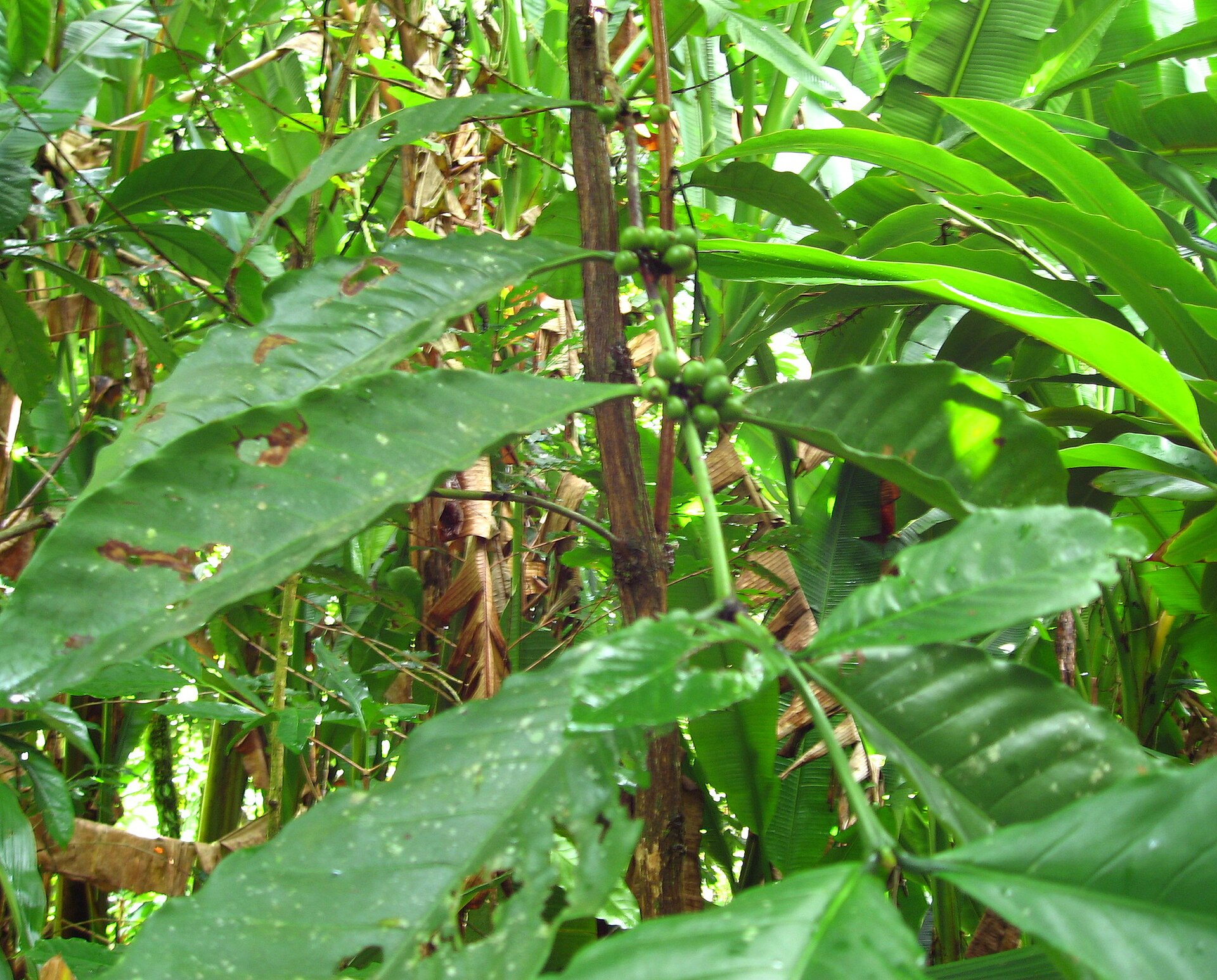
Arabica coffee
Coffea arabica L.
Arabica coffee (Coffea arabica L.) is a small evergreen tree in the coffee family (Rubiaceae) whose berry ('cherry') holds two coffee beans; it is the world's most widely grown coffee species, accounting for about 60% of global coffee products. According to Kew POWO its native range is E. South Sudan, SW. Ethiopia and N. Kenya (Mt. Marsabit), with Yemen as a secondary centre of spread from the 14th century. The bean contains caffeine (about 1.2–1.5% of dry weight) and chlorogenic acids (5–8%), plus trigonelline and the diterpenes cafestol/kahweol that shape flavour and aroma. In Vietnam, coffee is the key cash crop of the Central Highlands (Dak Lak, Lam Dong, Gia Lai, Dak Nong).
No ratings yet — be the first!
Gallery
 Coffee — Cherry & beansCà phê · ảnh 1
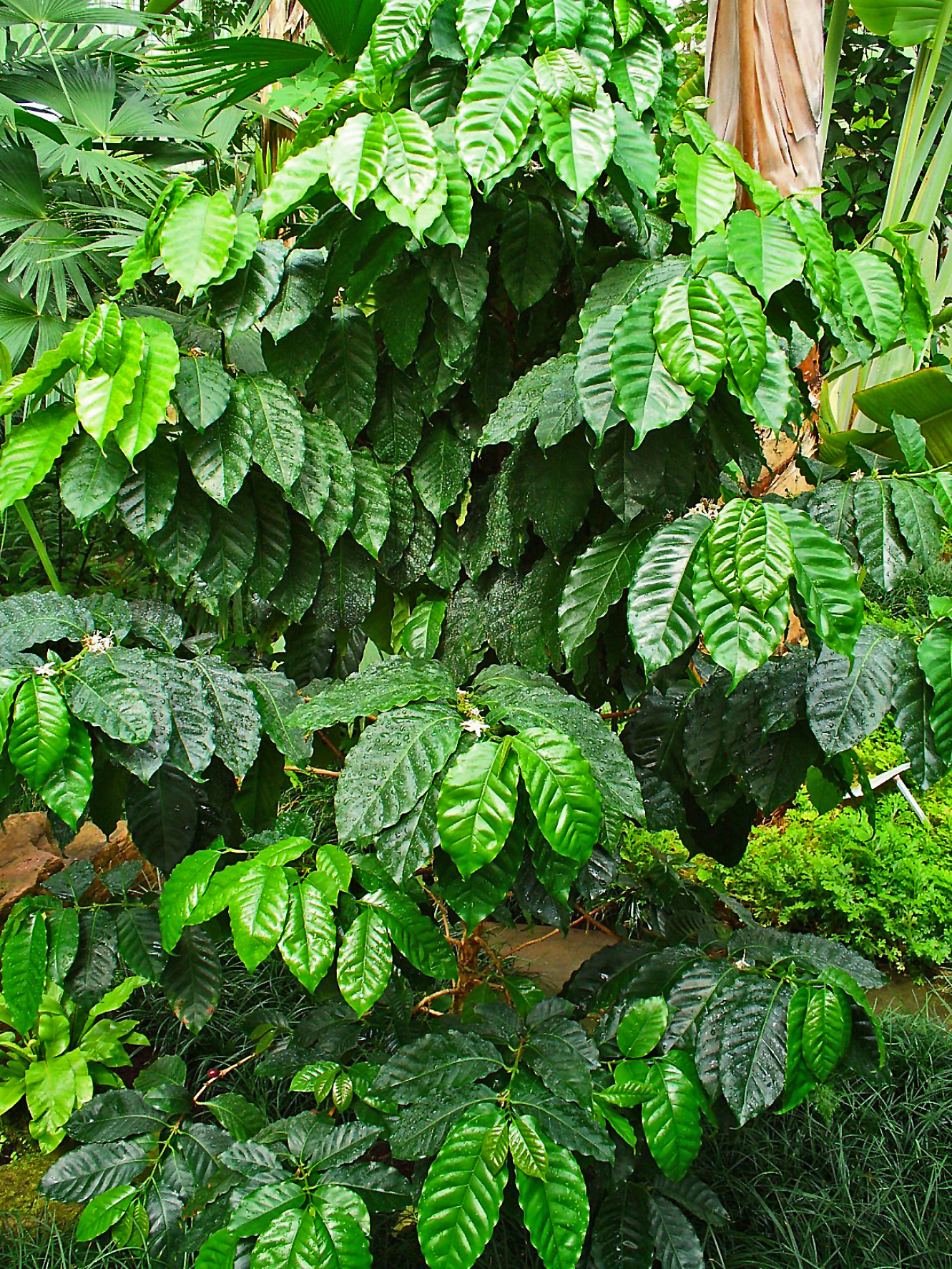 Lá xanh
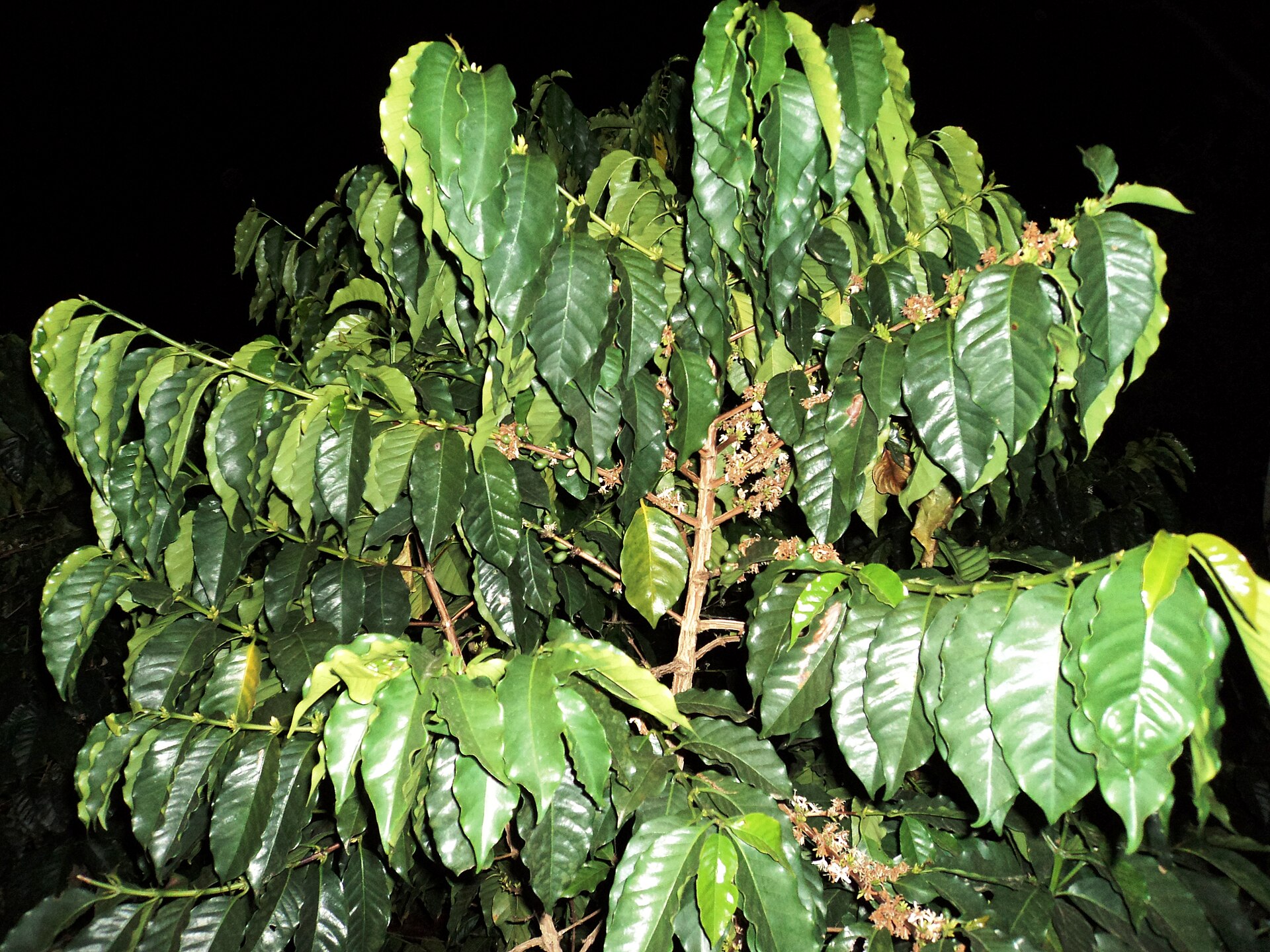 Cà phê · ảnh 3
 Coffee — Plantation
 Coffee — Fruiting branchCoffee — Cherry & beansCà phê · ảnh 1
Photo credits: Liné1 (CC BY 2.5) · H. Zell (CC BY-SA 3.0) · Los investigadores (CC BY-SA 3.0)
Overview
Arabica coffee is a small evergreen tree or large shrub, 4–8 m tall in cultivation (up to 15 m in the wild), with opposite branching. The leaves are opposite, simple, ovate to elliptic, leathery and glossy, 10–15 cm long, with slightly wavy margins and stipules at the nodes. The flowers are bisexual, white and fragrant, usually 5-merous, borne in clusters of 2–4 in the leaf axils; the tree is mainly self-pollinating (about 90%), which makes populations genetically fairly uniform. The fruit is a drupe (the 'cherry'), ellipsoid and about 1.5 cm long, turning from green through yellow to red when ripe, usually containing two flat seeds (beans) each with a central groove on the flat face. The roots are shallow and fibrous, so the plant needs loose, organic-rich soil. Coffea arabica is an allotetraploid with 2n = 4x = 44.
According to Kew POWO the native range of Coffea arabica is E. South Sudan (Boma Plateau), SW. Ethiopia and N. Kenya (Mt. Marsabit), growing in humid evergreen forest and seasonally dry tropical habitat at roughly 1,000–2,000 m. The centre of origin and diversity is the highland forest of southwestern Ethiopia, South Sudan and northern Kenya; because the species is largely self-pollinating its genetic diversity is naturally low. From the 14th century coffee seeds were carried from Ethiopia to Yemen, where cultivation expanded and became a secondary centre of dispersal worldwide through the Typica and Bourbon lineages (Scalabrin et al., 2020). Coffee reached Vietnam in the 19th century under French rule and now centres on the Central Highlands (Dak Lak, Lam Dong, Gia Lai, Dak Nong) and Son La; Vietnam is the world's second-largest coffee exporter, mainly robusta, while arabica is concentrated in Lam Dong, Son La and Dien Bien. Brazil is the largest coffee producer, followed by Colombia, Vietnam, Indonesia and Ethiopia.
Chemically, the arabica bean contains more than 1,000 compounds, whose core functional groups are caffeine, chlorogenic acids (CGAs), trigonelline, the diterpenes cafestol and kahweol, and roast-derived melanoidins. Caffeine is a methylxanthine making up about 1.2–1.5% of the dry weight of arabica (lower than robusta – Coffea canephora, at 1.7–4%). Chlorogenic acids are a polyphenol group forming 5–8% of dry weight, with 5-O-caffeoylquinic acid (5-CQA) predominant (36–40% of total CGAs); about one third of ingested 5-CQA reaches the systemic circulation, peaking in plasma within 0.5–1.5 h. Trigonelline is the characteristic alkaloid (about 1% of dry weight), contributing to roast aroma and showing anti-diabetic potential. The diterpenes cafestol and kahweol are abundant in unfiltered coffee (espresso, French press) and can raise blood cholesterol. During roasting, Maillard reactions generate melanoidins and aroma compounds (pyrazines, furans, lactones) while reducing CGAs. Green beans also contain protein (~11%), lipids (~12%), carbohydrates and minerals (potassium, magnesium).
Coffee is one of the world's most popular drinks: roasted beans are brewed as espresso, phin or filter coffee; they flavour cakes, confectionery and ice cream; caffeine is extracted for energy drinks and medicines; coffee leaves are used as a polyphenol-rich 'coffee-leaf tea'; and spent grounds go into exfoliants, compost and growing media. In research, a review (PMC, 2024) summarised the effects of coffee's core functional components (caffeine, trigonelline, CGAs, cafestol, kahweol, melanoidins): CGAs activate the antioxidant Nrf2 pathway and inhibit α-glucosidase to modulate postprandial glycaemia, and a 9-year follow-up linked coffee drinking to lower risk of Alzheimer's-related dementia (ADRD) and Parkinson's disease. Caffeine content per serving ranges from 48 to 317 mg (Ludwig et al., 2014). Koshiro et al. (2006) analysed changes in caffeine and trigonelline during fruit ripening, and de Andrade et al. (2023) showed that both caffeine and trigonelline play antioxidant roles. The allotetraploid genome of C. arabica has been sequenced (Salojärvi et al., Nature Genetics, 2024).
On safety, according to the European Food Safety Authority (EFSA, 2015) healthy adults can take up to 400 mg caffeine a day (single doses up to 200 mg); pregnant women should limit intake to 200 mg/day and children to 3 mg/kg/day. Heavy intake of unfiltered coffee (espresso, French press) can raise LDL cholesterol because of cafestol and kahweol. Coffee can cause anxiety, insomnia and palpitations in sensitive people and interacts with some medicines; roasting forms acrylamide and green beans may carry ochratoxin A (quality control needed). Epidemiological research shows that moderate intake of 3–4 cups a day (300–400 mg caffeine) carries little risk and may be beneficial (Higdon & Frei, 2006); IARC (2016) classifies coffee in Group 3 (not classifiable as to carcinogenicity), while very hot drinks above 65 °C are Group 2A. On conservation, the International Union for Conservation of Nature (IUCN) lists Coffea arabica as Endangered (EN) in its 2020 assessment (Moat et al., e.T18289789) because climate change sharply contracts the suitable habitat of wild populations; Kew POWO also records a provisional Vulnerable (VU) assessment. The main risks are climate change, deforestation, coffee leaf rust (the fungus Hemileia vastatrix) and the narrow genetic base that stems from a single polyploidisation event. Conservation priorities are to protect wild populations in Ethiopia, South Sudan, Kenya and Yemen and to maintain genebanks (such as CATIE and World Coffee Research).
Life cycle
From seed to productSeed
Each cherry holds two flat seeds with a central groove — the coffee bean. Growers use fresh seed and keep it evenly moist ahead of sowing.
Germination
Fresh coffee seeds germinate in 2 – 4 weeks with even moisture; the sprout grows slowly and needs shade and high humidity.
Seedling
After 6 – 12 months seedlings reach 30 – 50 cm with dark green leaves; nurseries typically shade 50 – 70% of light before transplanting.
Mature plant
A small evergreen tree favouring cool highland conditions of 15 – 24 °C on fertile, well-drained soil; three to four years after planting it matures and begins to bear.
Flowering & fruiting
Fragrant white flowers cluster in the leaf axils; the green fruit swells and ripens red after about 8 – 11 months.
Harvest
Ripe cherries are hand-picked or machine-shaken, then processed by the wet method (pulping, fermenting, washing, drying) or the dry method to yield green coffee for roasting.
Distribution & origin
Share of recorded occurrences by region- Brazil40%
- Colombia14%
- Vietnam & Indonesia12%
- Ethiopia10%
- Central America (Guatemala, Honduras)9%
- India, Peru & Kenya7%
- Elsewhere8%
Chemical composition
Relative content in agarwood resin- Carbohydrates & fibreSeed cell-wall matrix38%
- Lipids (coffee oil; cafestol, kahweol)Diterpenes that can raise cholesterol16%
- Protein & amino acidsAbout 11% of green bean11%
- Chlorogenic acids (CGAs, mainly 5-CQA)5–8% of dry weight; antioxidant10%
- Caffeine1.2–1.5% of dry weight5%
- Trigonelline~1% of dry weight; anti-diabetic potential5%
- Minerals (potassium, magnesium)Potassium abundant in the bean5%
- Aroma compounds & melanoidinsFormed on roasting (pyrazines, furans, lactones)10%
Uses
- Beverages: espresso, phin and filter brewing
- Food ingredient: coffee-flavoured cakes, sweets and ice cream
- Natural caffeine extraction for energy drinks and medicines
- Polyphenol-rich coffee-leaf tea (functional beverage)
- Spent grounds in exfoliants, compost and growing media
- Research/medicinal: antioxidant CGA & trigonelline, glycaemic support
Properties
- Taste & aroma
- Sweet-acidic, fruity to cocoa notes
- Bean shape
- Oval, central groove along the flat face
- Typical roast range
- 180 – 230 °C
- Genome
- Allotetraploid, 2n = 44
Habitat & conservation
Humid tropical highland forest and seasonally dry tropical habitat, roughly 600–2,000 m; rainfall 1,500–2,000 mm a year, optimum temperature 15–24 °C. Deep, organic-rich, friable and well-drained soils at pH 5.5–6.5. Young plants need shade and plantations usually keep shade trees; the species prefers a cool highland climate and tolerates neither heat nor frost. In Vietnam arabica suits Lam Dong, Son La and Dien Bien.
Conservation
The IUCN lists Coffea arabica as Endangered (EN) in its 2020 assessment (Moat et al., e.T18289789): when climate projections are modelled, suitable habitat for wild populations across the Ethiopian, South Sudanese and Yemeni highlands contracts sharply compared with the original Least Concern (LC) reading; Kew POWO records a provisional Vulnerable (VU) assessment. Wild populations remain only in Ethiopia, South Sudan, Kenya and Yemen. The main risks are climate change, deforestation, coffee leaf rust (Hemileia vastatrix), some root and fungal diseases, and the narrow genetic base caused by the species' origin in a single polyploidisation event. Conservation priorities are to protect wild populations in situ and to keep germplasm in genebanks (CATIE, World Coffee Research, the Ethiopian coffee genebank).
References
- 1Plants of the World Online — Coffea arabica L. — Kew Science, 2026
- 2Coffea arabica — IUCN Red List e.T18289789 (đánh giá 2020, Moat và cộng sự) — International Union for Conservation of Nature (IUCN), 2020
- 3A single polyploidization event at the origin of the tetraploid genome of Coffea arabica — Scalabrin et al., Scientific Reports, 2020
- 4The genome and population genomics of allopolyploid Coffea arabica — Salojärvi et al., Nature Genetics, 2024
- 5Variations in caffeine and chlorogenic acid contents of coffees — Ludwig et al., Food & Function, 2014
- 6Coffee and health: a review of recent human research — Higdon & Frei, Critical Reviews in Food Science and Nutrition, 2006
- 7Changes in content and biosynthetic activity of caffeine and trigonelline during growth and ripening of Coffea arabica fruits — Koshiro et al., Plant Science, 2006
- 8Health effects of coffee's core functional components on chronic diseases (tổng quan) — PMC/NCBI, 2024
- 9IARC Monographs — Coffee, maté, very hot beverages — International Agency for Research on Cancer (IARC/WHO), 2016