
Sugarcane
Saccharum officinarum L.
Sugarcane (Saccharum officinarum L.) is a perennial grass of the family Poaceae whose jointed stalks grow 2–7 m tall and store sucrose in the internodes, the main raw material of the sugar industry and of bioethanol. According to Kew POWO it is native to New Guinea and was domesticated by Papuans from the wild ancestor Saccharum robustum about 6,000 years ago, then spread across the tropics by Austronesian voyagers. It is the world's largest crop by production quantity (about 1.9 billion tonnes in 2020), with Brazil accounting for roughly 40%. Besides sucrose, cane juice is rich in polyphenols (caffeic, chlorogenic, tricin, apigenin, luteolin) and cane wax contains policosanols (octacosanol) and D-003. In Vietnam it is grown in Thanh Hoa, Nghe An, Phu Yen, Tay Ninh and Hau Giang, among others, for sugar and fresh juice.
No ratings yet — be the first!
Gallery
 Sugarcane — LeavesSugarcane — Plant
 Sugarcane — Stems & leaves
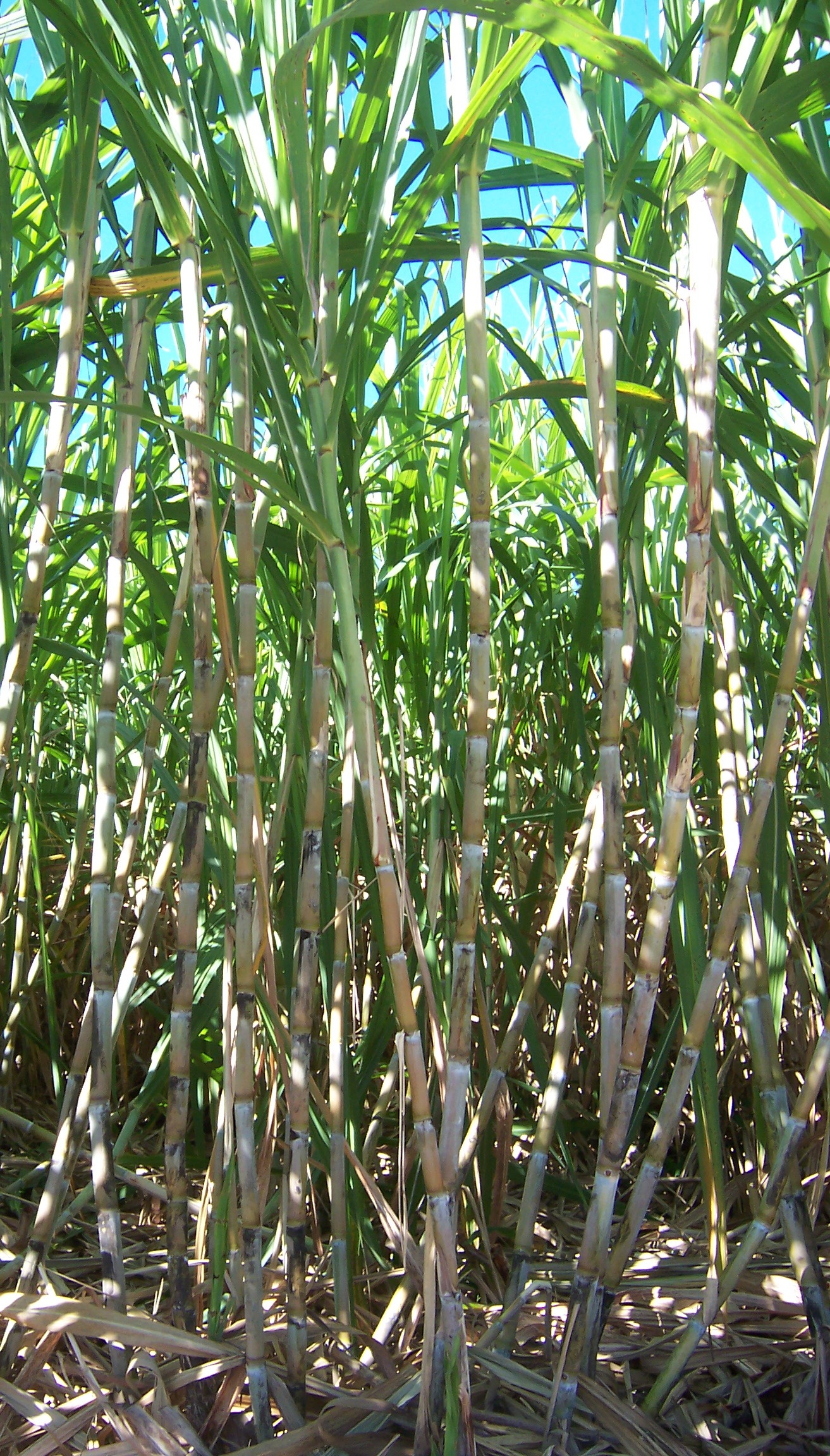 Sugarcane — Yellow canes
 Sugarcane — Red canes
 Sugarcane — Flowering caneSugarcane — LeavesSugarcane — Plant
Overview
Sugarcane (Saccharum officinarum) is a perennial grass forming clumps of upright, unbranched stalks 2–7 m tall (usually 3–4 m) and about 5 cm in diameter. The stalk is jointed like bamboo, its internodes filled with a white fibrous pith soaked in sugary sap; a bud sits at the base of each leaf. The leaves are two-ranked, the blade narrow and 30–60 cm long with a thick midrib and small hard serrated margins; the sheath clasps the stem. The inflorescence is a panicle up to 60 cm long bearing many small spikelets with silky white hairs; the fruit is dry with one seed, but viable seed is rarely set. Sugarcane uses C4 photosynthesis, giving very high biomass, and reproduces mainly vegetatively from setts (stem sections bearing at least one bud). The chromosome number is 2n = 80; modern commercial cultivars are complex hybrids among several species of the genus.
According to Kew POWO the native range of Saccharum officinarum is New Guinea (LSID urn:lsid:ipni.org:names:419977-1); it is a rhizomatous perennial grass of seasonally dry tropical habitat. Sugarcane was domesticated by Papuans in New Guinea and the islands east of the Wallace Line, selected from the wild ancestor Saccharum robustum about 6,000 years ago; New Guinea remains the centre of diversity. From there it spread to maritime Southeast Asia, then with Austronesian voyagers to Polynesia and Micronesia about 3,500 years ago and westward to China and India about 3,000 years ago. Arab traders brought cane to the Mediterranean from the 8th century, and in 1493 Columbus took it to the Caribbean. Today it is grown throughout the tropics and subtropics, mostly between 22°N and 22°S, in places up to 33° and to about 1,600 m near the equator. Brazil is the largest producer (about 40% of world output), followed by India, China and Thailand.
The ripe stalk contains about 63–73% water, 12–16% soluble sugars, 11–16% fibre and 2–3% non-sugar carbohydrates. Pressed cane juice is about 70–75% water, 13–15% sucrose and 10–15% fibre; sucrose (saccharose) is the chief active, giving the sweetness and serving as the sugar industry feedstock, with small amounts of glucose and fructose. Besides sugar, the juice is rich in polyphenols: phenolic acids such as caffeic, chlorogenic, sinapic and hydroxycinnamic acid, together with the flavones apigenin, luteolin and tricin — tricin derivatives being the most abundant — and many flavone C-/O-glycosides (orientin, vitexin, schaftoside, swertisin). The cane wax coating stems and leaves (about 0.1–0.3% by weight) is a source of policosanols — long-chain aliphatic alcohols with octacosanol making up 50–80% — and of the fatty-acid mixture D-003, along with phytosterols and terpenoids. Bagasse is mainly cellulose, hemicellulose and lignin.
Sugarcane is a multi-purpose industrial crop. Cane juice is pressed to make refined sucrose (white sugar); unrefined products include raw sugar, brown sugar, jaggery and molasses; molasses is fermented into bioethanol — Brazil being the largest producer of sugarcane ethanol — as well as rum and vinegar. Bagasse is burned for biomass power (cogeneration) and made into paper, board and animal feed; cane tops and leaves serve as fodder; cane wax is a source of policosanols and is regarded as a carnauba-wax substitute in cosmetics and pharmacy. In research, the policosanol mixture from cane wax lowered total and LDL cholesterol in rabbits (Arruzazabala et al., 1994; 2000); D-003 has antiplatelet and antithrombotic effects (Molina et al., 2000; 2002); a fatty-acid mixture from cane wax has anti-inflammatory and analgesic effects (Ledón et al., 2003); and saccharin A–F glycans from the stalk lower blood glucose in mice (Takahashi et al., 1985). Cane-juice polyphenol extract shows strong antioxidant and DNA-protective activity (Duarte-Almeida et al., 2006), and an acylated tricin glycoside has antiproliferative activity against cancer cells (Duarte-Almeida et al., 2007). Reviews by Singh et al. (2015) and Ali et al. (2021) systematise the pharmacology of sugarcane and its by-products, and sugarcane polyphenol extract continues in clinical trials on metabolism and immunity (Penglase et al., 2022).
On safety, heavy consumption of cane sugar raises the risk of dental caries, excess weight and type 2 diabetes; the World Health Organization recommends keeping free sugars below 10% (ideally below 5%) of dietary energy. Because of the practice of burning cane fields before harvest, cane juice may carry polycyclic aromatic hydrocarbons (PAHs) such as benzo[a]anthracene and benzo[a]pyrene (Silvia et al., 2009); field-burning smoke pollutes the air, and bagasse dust is linked to respiratory disease in workers. Fresh unpasteurised cane juice may carry bacteria and needs hygienic handling. On conservation, the International Union for Conservation of Nature (IUCN) has not assessed Saccharum officinarum (NE) because it is a global crop. The species is a domesticated cultigen; cultivated genetic diversity is held in the many varieties and in genebanks worldwide (such as USDA-ARS, CIRAD and the ICAR Sugarcane Breeding Institute, Coimbatore, India). The main threats are landraces being replaced by a few high-yielding hybrids, monoculture prone to disease outbreaks (smut, mosaic, ratoon stunting disease), pests, drought and climate change; conservation of wild relatives (S. spontaneum, S. robustum) as breeding resources is therefore important.
Life cycle
From seed to productStem cutting
Propagated by **stem cuttings**: take 10–15 cm semi-hardwood cuttings with 2–3 nodes and insert them in moist sand or soil in shade.
Rooting
Cuttings root within 2–4 weeks and new shoots break from the nodes.
Growth & flowering
The plant blooms with **soft white flower plumes, October–December**; pollination is by insects and wind.
Maturity & harvest
Stems elongate and accumulate the harvested product; **ripe cane harvested 10–14 months after planting**.
Distribution & origin
Share of recorded occurrences by region- Brazil38%
- India21%
- China7%
- Thailand6%
- Pakistan5%
- Mexico, Colombia & United States8%
- Southeast Asia (Indonesia, Philippines, Vietnam)7%
- Elsewhere8%
Chemical composition
Relative content in agarwood resin- WaterAbout 63–73% of the ripe stalk66%
- Sucrose (cane sugar)12–16% soluble sugars; the chief active14%
- Fibre (cellulose, bagasse)11–16% of the stalk; source of bagasse and paper13%
- Other carbohydrates (glucose, fructose)2–3% non-sugar carbohydrates2%
- Polyphenols & flavonoidsCaffeic acid, chlorogenic acid, tricin, apigenin, luteolin2%
- Cane wax — policosanols & D-003Wax 0.1–0.3%; octacosanol 50–80% of policosanols1%
- Protein, minerals & vitaminsPotassium, calcium, magnesium; B vitamins1%
- Lipids, phytosterols & organic acidsPhytosterols, organic acids (aconitic)1%
Uses
- Production of refined sucrose (white sugar)
- Food: cane juice, raw sugar, brown sugar, jaggery, molasses, rum, vinegar
- Biofuel: ethanol from molasses and cane juice (Brazil)
- Bagasse: biomass power (cogeneration), paper, board, animal feed
- Cane wax & policosanols: cosmetics, excipients, functional foods
- Traditional medicine & research: diuretic, liver support; antioxidant polyphenols
Properties
- Used part
- Stalk
- Taste
- Sweet
Habitat & conservation
Hot, humid tropical and subtropical regions, mostly between 22°N and 22°S (in places up to 33°) and up to about 1,600 m near the equator. The crop needs at least about 60 cm of water a year from rain or irrigation over 6–7 months of growth, temperatures around 20–35 °C, full sun and freedom from frost. Soils should be deep, well drained and rich in organic matter, from alluvial to red and irrigated sandy soils.
Conservation
The IUCN has not assessed Saccharum officinarum (NE), as it is a global crop rather than a threatened wild population. Sugarcane genetic diversity is held in the many varieties and in genebanks and world collections (such as USDA-ARS, CIRAD and the ICAR Sugarcane Breeding Institute, Coimbatore, India). Modern cultivars are complex hybrids, so wild relatives (S. spontaneum, S. robustum) are very important for breeding. The main risks are landraces being replaced, monoculture, diseases (smut, mosaic, ratoon stunting disease), pests, drought and climate change.
References
- 1Plants of the World Online — Saccharum officinarum L. (Sp. Pl.: 54, 1753) — Kew Science, 2026
- 2Phytochemical profile of sugarcane and its potential health aspects — Singh et al., Pharmacognosy Reviews, 2015
- 3A phytochemical and pharmacological review of sugarcane (Saccharum officinarum L.) and its by-products — Ali et al., ScienceDirect, 2021
- 4Antioxidant activity of phenolic compounds from sugarcane (Saccharum officinarum L.) juice — Duarte-Almeida et al., Plant Foods for Human Nutrition, 2006
- 5Antiproliferative and antioxidant activities of a tricin acylated glycoside from sugarcane juice — Duarte-Almeida et al., Phytochemistry, 2007
- 6Antiplatelet and antithrombotic effect of D-003 — Molina et al., Pharmacological Research, 2000
- 7Cholesterol-lowering effects of policosanol in rabbits — Arruzazabala et al., Biological Research, 1994
- 8Anti-inflammatory and analgesic effects of a mixture of fatty acids isolated from sugarcane wax oil — Ledón et al., Planta Medica, 2003
- 9Polycyclic aromatic hydrocarbons in sugarcane juice — Food Chemistry, 2009
- 10The effects of a natural polyphenol extract from sugarcane (Saccharum officinarum) on metabolism and immunity — Penglase et al., Applied Sciences (MDPI), 2022
- 11FAOSTAT — Crops and livestock products (sugarcane production) — Food and Agriculture Organization of the UN (FAO), 2023