
All plant species
83 species LC
Abies alba
Abies alba
Pinaceae
Abies alba, the European silver fir or silver fir, is a fir native to the mountains of Europe, from the Pyrenees north to Normandy, east to the Alps and the Carpathians, Slovakia, Slovenia, Croatia, Bosnia and Herzegovina, Montenegro, Serbia, and south to Italy, Bulgaria, Kosovo, Albania and northern Greece.
 VU
African mahogany
Khaya senegalensis (Desr.) A.Juss.
Meliaceae (mahogany family)
Khaya senegalensis (African mahogany), also called Senegal mahogany, is a large tree of the mahogany family (Meliaceae) native to the dry zones of West and Central Africa, prized for a handsome, durable, termite-resistant mahogany timber used for fine furniture, boats and musical instruments. It grows 15–30 m tall, with pinnate leaves, small cream-white flowers and round capsules that split into 4–5 valves with winged seeds. In Vietnam it is widely planted as a shade tree and for timber. Over-exploitation in its native range led IUCN to list it as Vulnerable (VU), though most commercial timber now comes from plantations.
 LC
Alopecurus aequalis
Alopecurus aequalis
Poaceae
Alopecurus aequalis is a common species of grass known as shortawn foxtail or orange foxtail. It is native to much of the temperate Northern Hemisphere from Eurasia to North America. It is most commonly found in areas near fresh water, such as the margins of ponds and ditches.
 NE
Andrographis / Green chiretta
Andrographis paniculata
Acanthaceae family
Green chiretta (Andrographis paniculata), also called the 'king of bitters', is an annual herb in the Acanthaceae family native to India and Sri Lanka, widely cultivated across South and Southeast Asia as a cooling, detoxifying medicine for respiratory infections.
 NE
Anemone caroliniana
Anemone caroliniana
Ranunculaceae
Anemone caroliniana, the Carolina anemone, is a species of herbaceous flowering plant in the family Ranunculaceae. Plants grow (7)10 to 40 cm tall, from short tuber-like rhizomes that are 10–30 mm long. Stem leaves without petioles. Plants flowering early to mid spring with the flowers composed of 10 to 20 sepals (sometimes called tepals) normally white or soft rose colored but also purple, one flower per stem, the sepals are 10 to 22 mm long and 2–5 mm wide. Fruits in heads ovoid to subcylindric in shape, 17–25 mm long.
 NE
Aristida vagans
Aristida vagans
Poaceae
Aristida vagans, the threeawn speargrass, is a species of grass native to Australia. Found in dry eucalyptus woodland or forest, it may reach 80 cm (30 in) tall. The specific epithet vagans is from Latin, meaning "wanderer". The plant was first collected by botanists in Sydney, and published in 1799 by the Spanish taxonomist Antonio José Cavanilles.
 LC
Asiatic pennywort
Centella asiatica (L.) Urb.
Apiaceae (carrot family)
Asiatic pennywort (Centella asiatica) is a small creeping herb of moist ground, rich in triterpene saponins (asiaticoside, madecassoside) that support wound healing, skin repair and cooling; its young leaves are eaten raw or juiced.
 LC
Asimina obovata
Asimina obovata
Annonaceae
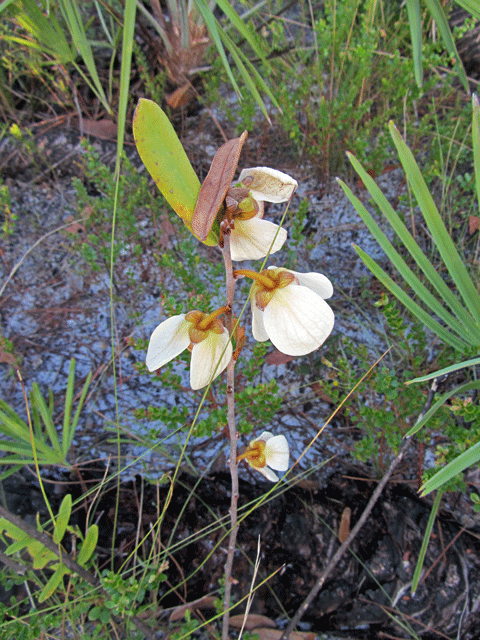
Asimina obovata, the bigflower pawpaw, is a shrub or small tree in the custard apple family. It is an endemic native to Florida, where it is found on open sandy hammocks and in dry woods. Showy white flowers in late winter to early summer are followed by large green edible fruit. Its pollen is shed as permanent tetrads. Along with the other members of the genus, it serves as a host plant for the zebra swallowtail butterfly and pawpaw sphinx moth.
 NE
Asparagus racemosus
Asparagus racemosus
Asparagaceae
Asparagus racemosus (shatavari, asparagus fern) is a species of asparagus native from Africa through southern Asia, including the Indian subcontinent, to northern Australia. It grows 1–2 m (3 ft 3 in – 6 ft 7 in) tall and prefers to take root in gravelly, rocky soils high up in piedmont plains, at 1,300–1,400 m (4,300–4,600 ft) elevation. It was botanically described in 1799.88
 LC
Banana
Musa × paradisiaca L.
Musaceae (banana family)
Banana (Musa × paradisiaca) is really a giant herb, not a woody tree; it is grown throughout the tropics for its fruit — among the world's most important staple fruits — as well as for the male flower, leaves and stem.
 LC
Betel
Piper betle L.
Piperaceae (pepper family)
Betel (Piper betle) is an evergreen vine with glossy heart-shaped leaves, central to the age-old betel-chewing custom of Southeast Asia; the leaves are rich in hydroxychavicol, chavibetol and eugenol, giving antimicrobial, antifungal and antioxidant activity and research interest in oral care and cancer — but chewing betel quid with areca nut is IARC Group 1 (carcinogenic).
 LC
Bitter melon
Momordica charantia L.
Cucurbitaceae (gourd family)
Bitter melon (Momordica charantia) is an annual climbing vine with a warty, distinctly bitter fruit that contains charantin (sterol glucosides) and cucurbitane triterpenoids such as momordicosides. It is a well-known vegetable and folk remedy extensively studied for blood-glucose support.