
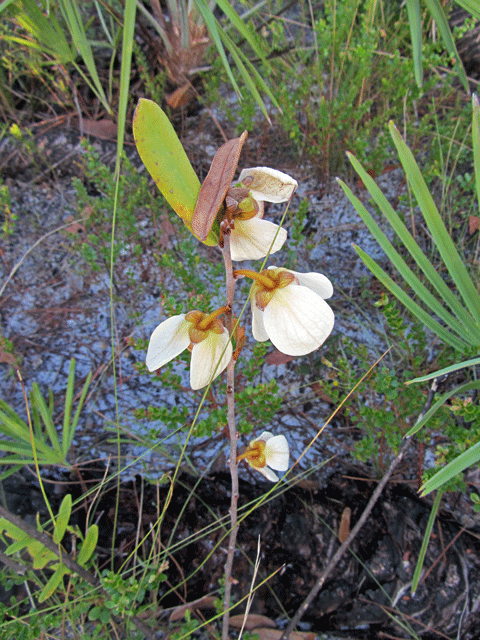
Asimina obovata
Asimina obovata
Asimina obovata, the bigflower pawpaw, is a shrub or small tree in the custard apple family. It is an endemic native to Florida, where it is found on open sandy hammocks and in dry woods. Showy white flowers in late winter to early summer are followed by large green edible fruit. Its pollen is shed as permanent tetrads. Along with the other members of the genus, it serves as a host plant for the zebra swallowtail butterfly and pawpaw sphinx moth.
No ratings yet — be the first!
Gallery
 Asimina obovata 181890300Asimina-obovata-c (8620673554)
 Asimina-obovata-b (8620673320)
 Asimina obovata
 Asimina obovata 126967146
 Asimina-obovata (8620672896)Asimina obovata 181890300Asimina-obovata-c (8620673554)
Overview
The leaves of A. obovata are alternately arranged and have pinnate venation. It may occur as a shrub or tree, with the potential to grow up to 3.5 meters (approximately 12 feet) in height. The flowers it produces may get up to 10 centimeters (approximately 4 inches) across, and fruit may reach a length of over 7 centimeters (approximately 3 inches).thumb|Asimina obovata in fruit
Life cycle
From seed to productSeed & germination
The plant is propagated mainly by **seed**: sow fresh or pre-treated seed in loose, moist soil and keep it evenly damp; germination follows within a few weeks.
Seedling & growth
Seedlings establish, forming leaves and roots; growth rate depends on light and moisture.
Flowering
The plant blooms with **maroon-brown flowers, early spring**; pollination is by insects and wind.
Fruiting & harvest
After flowering the plant sets fruit and seed; **yellow ripe fruits picked late summer–autumn**.
Distribution & origin
Share of recorded occurrences by region- United States97%
- Argentina1%
- Madagascar1%
- France1%
References
- 1Asimina obovata — Wikipedia — Wikipedia (CC BY-SA 4.0), 2026
- 2''Asimina obovata'' (Willd.) Nash — Plants of the World Online,
- 3Lady Bird Johnson Wildflower Center - The University of Texas at Austin — www.wildflower.org,
- 4''Asimina obovata'' — NatureServe Explorer,
- 5GBIF — occurrence records of Asimina obovata — GBIF, 2026
- 6IUCN Red List — Asimina obovata — IUCN, 2024
- 7Hình ảnh — Wikimedia Commons (6 ảnh, giấy phép CC/PD) — Wikimedia Commons, 2026