Fujian cypress
Fokienia hodginsii (Dunn) A.Henry & H.H.Thomas
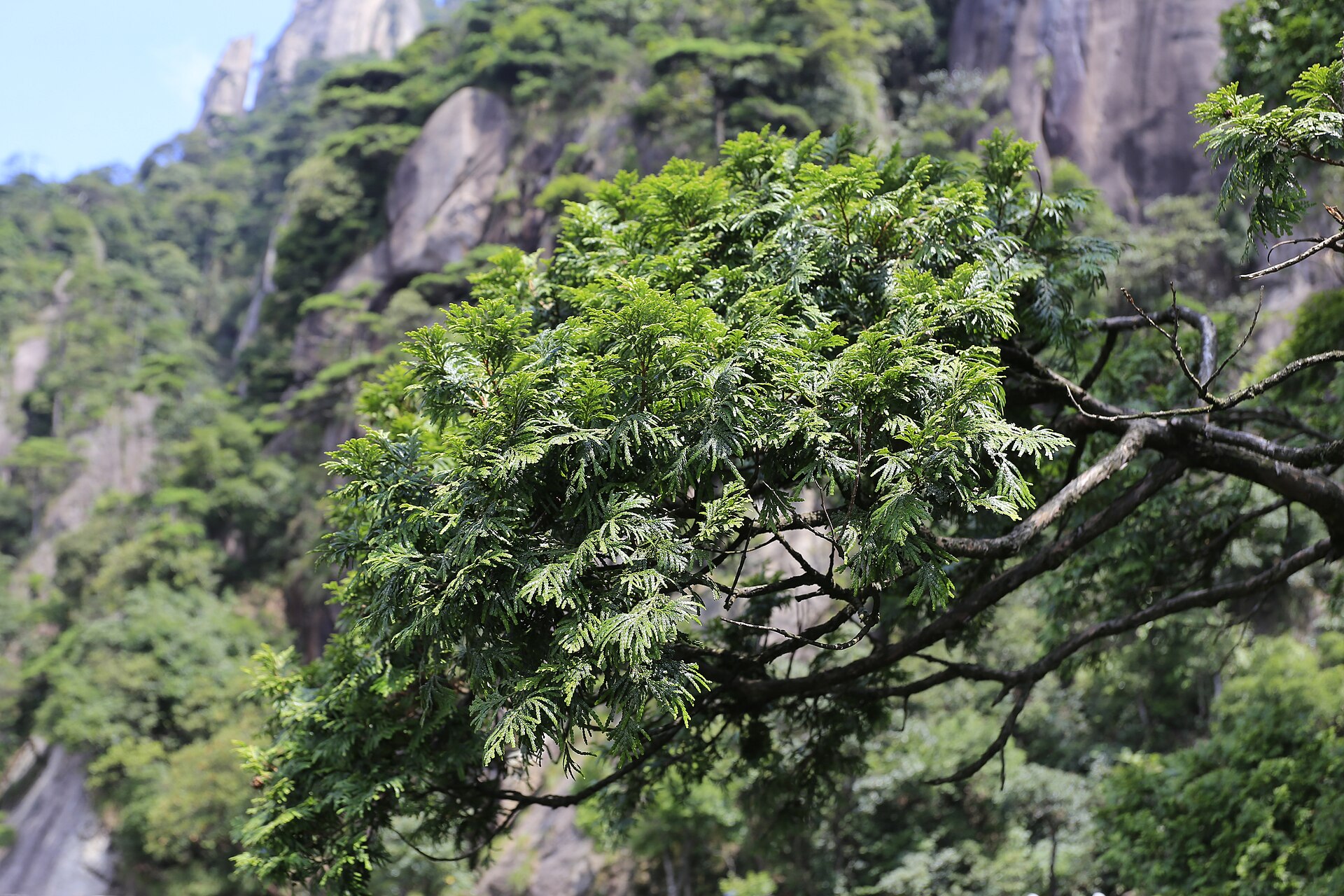
Fokienia hodginsii (Fujian cypress) is a prized cupressaceous conifer with light, fine-grained, aromatic, durable and termite-resistant wood, growing in humid montane closed evergreen forest in South-East Asia and southern China. It is an evergreen tree 20–30 m tall with a trunk that can exceed 1 m across and a conical crown; the scale-like leaves are aromatic when crushed. It is the sole species of its genus and a living relic of the Tertiary, ranging from China through Vietnam and Laos to Thailand and Myanmar. Over-exploitation of its timber led IUCN to list it as Vulnerable (VU).
No ratings yet — be the first!
Gallery
 FokieniaFujian cypress · photo 1
 Fujian cypress · photo 2
 Fujian cypress · photo 3
 Fokienia
 Fokienia
 FokieniaFokieniaFujian cypress · photo 1
Photo credits: Zhangzhugang (CC BY-SA 4.0)
Overview
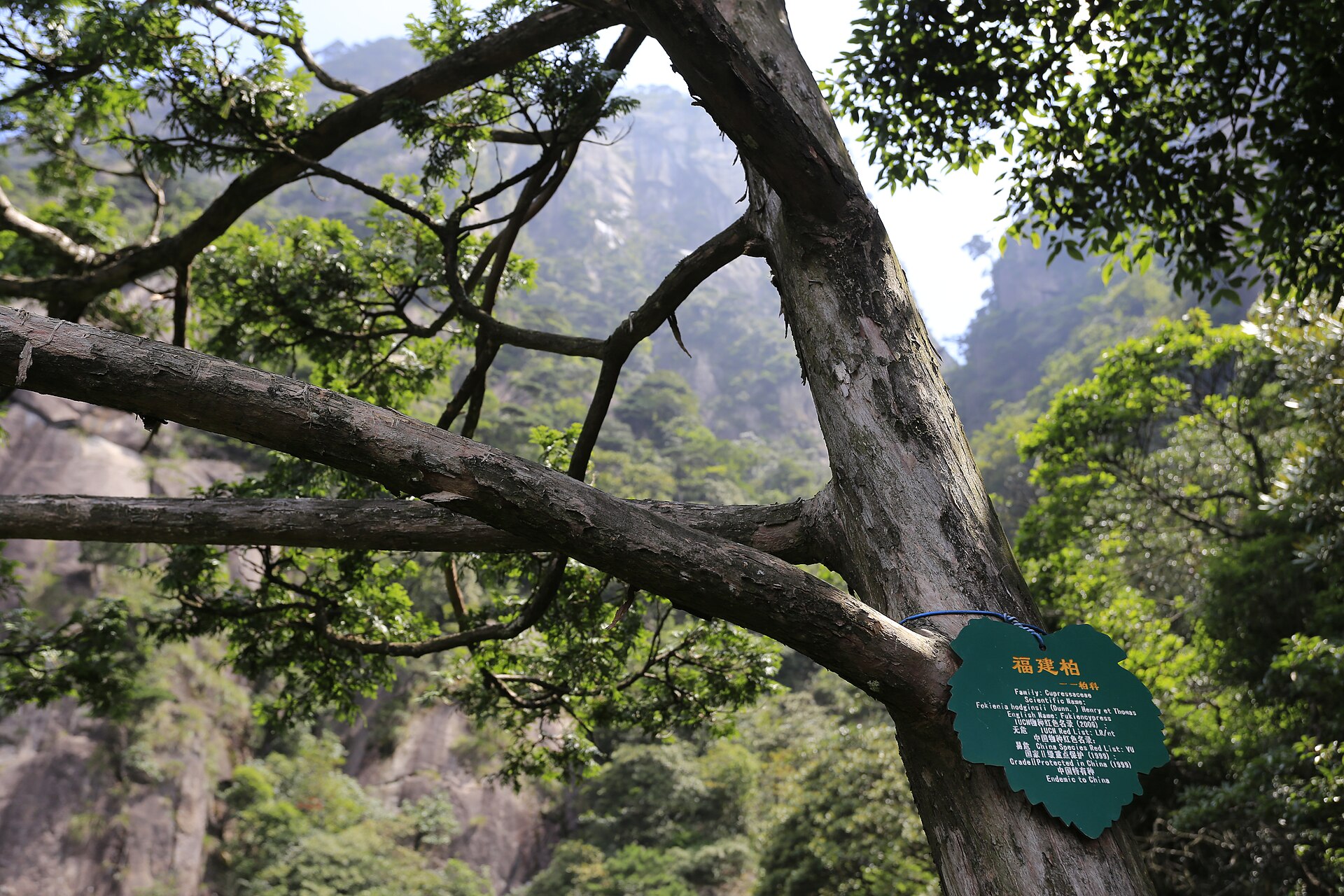
Fokienia hodginsii (Fujian cypress) is an evergreen cupressaceous tree 20–30 m tall with a trunk that can exceed 1 m in diameter and a handsome conical crown; the bark peels in scales. The scale-like leaves are arranged in flattened sprays and release a pleasant aroma when crushed. The species is monoecious; the male and female cones are small, the female cones globose and bearing winged seeds. Fokienia is a monotypic genus (containing only this one species) in the cypress family (Cupressaceae).
Updated by lebachungtdh@gmail.com · 10/08/2026
Fokienia hodginsii is a living relic of the ancient cupressaceous forests of the Tertiary, regarded as a “living fossil” among conifers. It ranges from southern and eastern China (where it was first described, in Fujian) through Vietnam and Laos to Thailand and Myanmar. It grows in humid montane closed evergreen forest on deep soils and is scarce in dry dipterocarp forest; its distribution is scattered and discontinuous. In Vietnam it is a prized timber species associated with high-mountain forests that need protection.
Updated by lebachungtdh@gmail.com · 10/08/2026
Fokienia wood is light (density 0.40–0.55 g/cm³), fine-grained, pleasantly aromatic, durable and termite-resistant — consisting mainly of cellulose, lignin and hemicellulose together with essential oil and aromatic extractives. The oil from the leaves and wood contains sesquiterpenes and terpenoids that give the characteristic fragrance and have been studied for antibacterial and insect-repellent activity. The aromatic, termite-resistant wood makes Fokienia prized for household items and carving, but is also the reason the species has been over-exploited.
Updated by lebachungtdh@gmail.com · 10/08/2026
Fokienia yields prized timber for furniture, boxes, trays, handicrafts, wooden statues and ritual items; because of its durability and termite resistance the wood is also used for poles, boards and structures. The fragrant oil from the leaves and wood is used as a fragrance material and is a subject of research, and the bark and wood also provide aromatic extractives. In daily life Fokienia wood is associated with high-grade craft products and traditional religious objects. The tree is also planted for ornament and montane protective forest.
Updated by lebachungtdh@gmail.com · 10/08/2026
Fokienia hodginsii is listed as Vulnerable (VU) by IUCN. It is logged for its aromatic wood and dug up because of its high economic value, while montane forest shrinks; the species regenerates slowly, so populations recover poorly after exploitation. As for safety, Fokienia wood and oil are not food; concentrated oil can irritate the skin, eyes and respiratory tract, must not be swallowed, and should be diluted for external use. Strict protection of natural populations and propagation are needed to conserve the gene pool.
Updated by lebachungtdh@gmail.com · 10/08/2026
Life cycle
From seed to productSeed
Po mu seeds are small and winged, falling from mature cones in the canopy; keep them cool and sow early to retain viability.
Germination
Seeds germinate beneath the moist montane canopy, where shade and cool air favour emergence.
Seedling
The seedling grows slowly with fragrant, bright-green scale leaves; it prefers shade and cool conditions and establishes well in canopy gaps.
Mature plant
At 20–30 m with trunks over 1 m across and flaking bark, its conical crown stands out in montane evergreen forest.
Logging
Timber is sawn and dried for furniture, carving and framing; aromatic foliage is distilled in essential-oil research.
Distribution & origin
Share of recorded occurrences by region- China32%
- Vietnam22%
- Laos15%
- Thailand10%
- Myanmar9%
- Other Indochina5%
- Planted elsewhere7%
Chemical composition
Relative content in agarwood resin- CelluloseWood cell-wall framework42%
- LigninHardness and termite resistance27%
- HemicelluloseBinds the cell wall20%
- Sesquiterpenes (essential oil)Characteristic fragrance6%
- Diterpenoids and aromatic phenolsAntibacterial, termite-resistant3%
- Others (resin, minerals, wax)Minor components2%
Uses
- Furniture, boxes, trays and handicrafts
- Carving, wooden statues and ritual items
- Poles, boards and construction structures
- Aromatic oil (leaves, wood) for fragrance and research
- Aromatic, termite-resistant wood for household use
- Ornamental and montane protective planting
Properties
- Colour
- Pale yellow to light brown
- Grain
- Fine, straight
- Scent
- Pleasantly aromatic
- Durability
- Durable, rot- and insect-resistant
Habitat & conservation
Humid montane closed evergreen and mixed forest on deep soils; ranges from southern and eastern China through Vietnam, Laos, Thailand and Myanmar. Usually scattered and discontinuous, scarce in dry dipterocarp forest.
Conservation
Fokienia hodginsii is listed as Vulnerable (VU) by IUCN. It is logged for its aromatic wood and dug up because of its high economic value, while montane forest shrinks; the species regenerates slowly, so populations recover poorly after exploitation.
References
- 1Fokienia hodginsii — The IUCN Red List of Threatened Species — IUCN, 2014
- 2Fujian cypress and two other threatened tree species in three protected areas of Vietnam — Journal of Forest Research, 2017
- 3Plants of the World Online — Fokienia hodginsii (Dunn) A.Henry & H.H.Thomas — Kew Science, 2024
- 4Fokienia hodginsii — Fujian cypress, description and uses — English Wikipedia, 2026
- 5Pơ mu — đặc điểm, gỗ thơm, công dụng — Vietnamese Wikipedia, 2026