

Tea tree
Melaleuca alternifolia (Maiden & Betche) Cheel
Tea tree (Melaleuca alternifolia) is a shrub to small tree of the myrtle family (Myrtaceae) native to eastern Australia, famous for a strongly antibacterial essential oil whose main component is terpinen-4-ol. The leaves contain 1–2% oil; under standard ISO 4730, commercial tea tree oil must have at least 30% terpinen-4-ol and no more than 15% 1,8-cineole. The oil is used as an antiseptic, for skin and acne care, hair care, as an antifungal and as a natural cleaner. IUCN lists it as Least Concern (LC).
No ratings yet — be the first!
Gallery
 Tea treeTea tree
 Tea tree
 Tea tree
 Tea treeTea treeTea tree
Overview
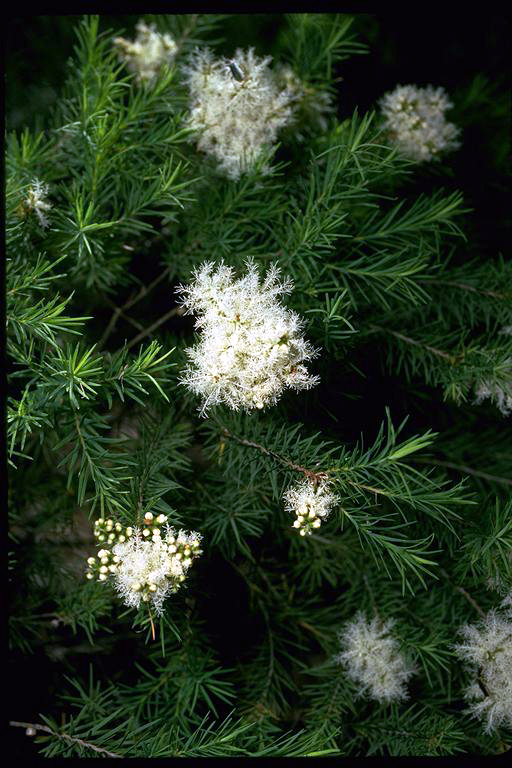
Tea tree is a shrub or small tree 2–6 m tall (sometimes to 8 m) with slender stems branched near the base. The bark is thin and peels in papery layers — typical of the genus Melaleuca. The leaves are alternate, very narrow and long (linear, 5–35 mm long and about 1 mm wide), rough to the touch and dotted with oil glands; crushed, they release a strong, distinctive aroma. The small cream-white flowers are borne in dense, brush-like spikes at the ends of the branches; the fruit is a small woody capsule, arranged along the branches and persistent.
Updated by lebachungtdh@gmail.com · 10/08/2026
Tea tree is a narrow endemic of eastern Australia, occurring naturally mainly in swamps and along streams in New South Wales and south-eastern Queensland, on seasonally flooded ground. It favours moist, acidic, nutrient-poor soils and tolerates flooding. Today the commercial oil supply comes chiefly from plantations in Australia, China, India and elsewhere, reducing pressure on wild populations.
Updated by lebachungtdh@gmail.com · 10/08/2026
Tea tree leaves contain 1–2% essential oil by fresh-leaf weight. Commercial tea tree oil meeting standard ISO 4730 must contain at least 30% terpinen-4-ol and no more than 15% 1,8-cineole. Besides terpinen-4-ol — the main antibacterial compound — the oil contains γ-terpinene, α-terpinene, α-terpineol, terpinolene, limonene and sesquiterpenes (aromadendrene, viridiflorol). The proportions depend on cultivar, growing region and harvest season.
Updated by lebachungtdh@gmail.com · 10/08/2026
Tea tree oil is widely used as an antiseptic and antifungal: for skin care and acne, for hair and scalp care (dandruff), for surface disinfection and natural cleaning, diluted as a mouthwash, against skin and nail fungi, and in insect-repellent preparations. In vitro studies show that terpinen-4-ol is active against many bacteria and fungi, including some antibiotic-resistant strains, and the oil also has mild anti-inflammatory effects. Tea tree oil is a common ingredient in cosmetics, cosmeceuticals and household care products.
Updated by lebachungtdh@gmail.com · 10/08/2026
Melaleuca alternifolia is listed as Least Concern (LC) by IUCN; the oil comes mainly from plantations, so pressure on wild plants is low, although native swamp habitat has shrunk. As for safety, tea tree oil must not be swallowed, must be diluted before applying to the skin, and must be kept away from the eyes and mucous membranes; it can irritate the skin and cause allergy in some people (test on a small area first). Do not use it on young children or in pregnancy without medical advice; keep it out of reach of children.
Updated by lebachungtdh@gmail.com · 10/08/2026
Life cycle
From seed to productSeed & germination
Tea tree seeds germinate in riverside wetlands; seedlings favour moisture and tolerate acidic soil.
Mature shrub
A 4–7 m shrub with narrow oil-rich leaves; it grows fast and is commonly planted in plantations.
Flowering
White bottlebrush flowers open around the branches in late winter–early spring, attracting bees.
Oil distillation
Fresh leaves are steam-distilled into oil rich in terpinen-4-ol, meeting the ISO 4730 standard.
Distribution & origin
Share of recorded occurrences by region- Australia (native, eastern)55%
- Planted in China12%
- Vietnam8%
- India6%
- New Zealand and South Africa6%
- Brazil and South America6%
- Elsewhere7%
Chemical composition
Relative content in agarwood resin- Terpinen-4-olMain antibacterial compound40%
- γ-TerpinenePrecursor of terpinene20%
- α-TerpineneAntibacterial9%
- 1,8-CineoleExpectorant (≤15% per ISO)7%
- α-TerpineolSoft aroma, antibacterial6%
- Others (terpinolene, limonene, sesquiterpenes)Minor compounds18%
Uses
- Antiseptic; skin and acne care
- Hair and scalp care (dandruff)
- Natural cleaning and surface disinfectant sprays
- Antifungal (skin and nail fungi)
- Diluted as a mouthwash
- Insect-repellent and mosquito-repellent preparations
Properties
- Oil colour
- Clear, pale yellow
- Scent
- Fresh, lightly camphor
- Standard
- ISO 4730
Habitat & conservation
Swamps and moist stream banks of eastern Australia, on seasonally flooded, acidic and nutrient-poor ground; the plant tolerates flooding and resprouts after disturbance. It is grown in Australia, China, India and elsewhere for its oil.
Conservation
Least Concern (IUCN: LC); the oil is mainly harvested from plantations, so pressure on wild plants is low. Native swamp habitat has shrunk through drainage and land development, so remaining wetlands need protection.
References
- 1ISO 4730 — Oil of Melaleuca, terpinen-4-ol type (tea tree oil) — ISO, 2023
- 2Antimicrobial activity of tea tree oil — Clinical Microbiology Reviews, 2020
- 3Melaleuca alternifolia — tea tree, description and uses — English Wikipedia, 2026
- 4Tràm trà — đặc điểm, tinh dầu, công dụng — Vietnamese Wikipedia, 2026
- 5Plants of the World Online — Melaleuca alternifolia — Kew Science, 2024