

Sensitive plant
Mimosa pudica L.
Sensitive plant (Mimosa pudica) is a low legume famous for its compound leaves that fold and droop when touched; it bears round pink powder-puff flowers and prickly flat pods, and is a pantropical weed native to South America.
No ratings yet — be the first!
Gallery
 Sensitive plant — Medicinal / ornamental (product)Sensitive plant — Plant
 Sensitive plant — Leaves
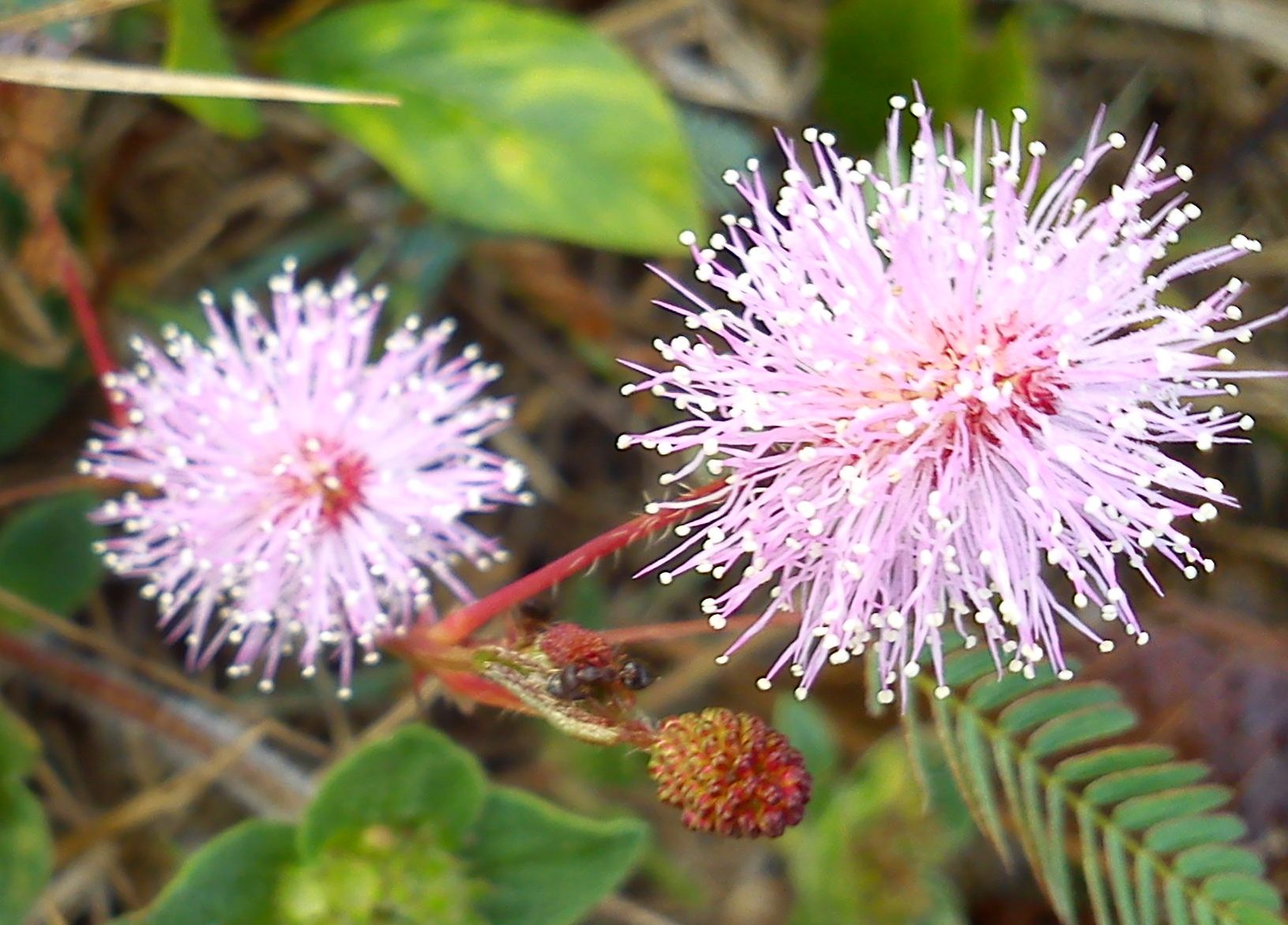 Sensitive plant — Flowers
 Sensitive plant — Prickly pods
 Sensitive plant — Thorny stem & branchesSensitive plant — Medicinal / ornamental (product)Sensitive plant — Plant
Overview
Sensitive plant (Mimosa pudica L.), also called touch-me-not, shame plant or sleepy plant, is a creeping to erect annual (sometimes biennial) herb of the legume family (Fabaceae), native to tropical Central and South America and now a pantropical and subtropical weed, including Vietnam. It grows 30–100 cm tall with slender, branched stems armed with small curved prickles. The leaves are twice-pinnate: each main stalk splits into 2–4 pairs of pinnae, each bearing many pairs of small oblong leaflets. Its famous trait is sensitivity: when touched, shaken, or in darkness, the leaflets fold inward and the whole leaf stalk droops, caused by a loss of turgor in the pulvinus cells at the leaf base (thigmonasty), reopening after a few minutes.
Updated by lebachungtdh@gmail.com · 10/10/2026
The small pink to pale purple flowers are crowded into round powder-puff heads about 1 cm across, borne in the leaf axils. The fruit is a flattened pod 1–2 cm long, covered with bristles or prickles, holding 2–5 flat brown seeds and splitting open when ripe. The plant grows fast on moist, open ground; in Vietnam it is common along roadsides, field edges and in gardens. It is grown as a curiosity plant for children and used as a folk medicine in many countries as a sedative and for insomnia and aches.
Updated by lebachungtdh@gmail.com · 10/10/2026
Life cycle
From seed to productPlant
A prickly creeping herb forming dense patches on open ground.
Leaves
Twice-pinnate leaves with many pairs of small leaflets.
Flowers
Round pink powder-puff flower heads.
Fruit
Flat prickly pods holding flat brown seeds.
Distribution & origin
Share of recorded occurrences by region- Tropical Central & South America (native)40%
- Southeast Asia & India (naturalised, incl. Vietnam)25%
- Africa & Madagascar12%
- Australia & Oceania10%
- Southern USA, Caribbean & Hawaii13%
Chemical composition
Relative content in agarwood resin- Water78%
- Fibre8%
- Mimosine & tannins5%
- Flavonoids (quercetin, kaempferol) & glycosides4%
- Saponins & alkaloids3%
- Essential oil & minerals2%
Uses
- Ornamental & curiosity: grown as a novelty plant; children love touching it to watch the leaves fold — hence names like 'shame plant' and 'touch-me-not'
- Folk medicine: root and leaf decoctions as a sedative for insomnia and anxiety; poultices for wounds, boils and snakebite; seeds for diarrhoea (India, Southeast Asia, China)
- Agriculture: ground cover against erosion, nitrogen-fixing green manure; partly used as fodder (limited by mimosine)
- Research & ecology: a model species for thigmonasty (touch-induced leaf movement); contains mimosine and antibacterial compounds under study
Properties
- Form
- Creeping-to-erect prickly herb
- Product
- Folk medicine (roots, leaves, seeds); ornamental plant
- Hallmark
- Leaves fold on touch; round pink powder-puff flowers
- Uses
- Sedative, insomnia remedy; antibacterial; ground cover
Habitat & conservation
Sensitive plant grows fast on moist, open, sunny ground; it is common along roadsides, field margins, waste ground, shifting cultivation plots and home gardens, tolerating poor soils. Native to tropical Central–South America, it is now naturalised throughout the tropics and subtropics: Southeast Asia (including Vietnam), India, Africa, Madagascar, Australia, Hawaii, the southern USA and the Caribbean.
Conservation
Not individually assessed by IUCN, but an extremely common pantropical invasive weed with no known threats, regarded as Least Concern (LC). Legume family (Fabaceae), genus Mimosa.
References
- 1Plants of the World Online — Mimosa pudica L. — Kew Science, 2026
- 2Mimosa pudica (Sensitive plant) — description, distribution, uses — Wikipedia tiếng Anh, 2026
- 3Trinh nữ (Mimosa pudica) — Wikipedia tiếng Việt — Wikipedia tiếng Việt, 2026
- 4含羞草 Mimosa pudica — 形态、分布与利用 — Wikipedia tiếng Trung, 2026
- 5Nguồn ảnh: Forest and Kim Starr (CC BY 3.0 US); Billjones94, Okkisafire, Nabunje Leticia (CC BY-SA 4.0) — Wikimedia Commons,
- 6Nguồn ảnh: Tony Hobbs (CC BY-SA 3.0); Manuspanicker (CC0) — hoa — Wikimedia Commons,